
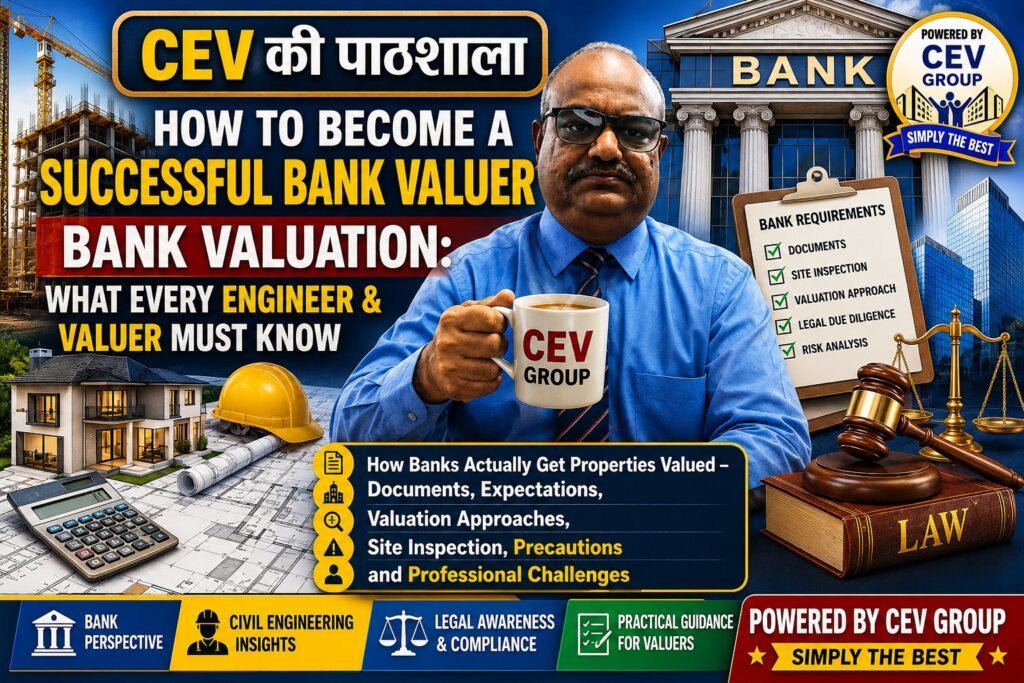


BANK VALUATION: WHAT EVERY ENGINEER & VALUER MUST KNOW
How Banks Actually Get Properties Valued – Documents, Expectations, Valuation Approaches, Site Inspection, Precautions and Professional Challenges
By CEV Research Wing
Property valuation for banks is one of the most responsible professional assignments undertaken by Engineers, Architects and Registered Valuers. A valuation report is not merely a statement of value; it is a professional opinion that directly influences lending decisions involving lakhs or even crores of rupees. A single error in valuation may expose the lender to financial loss, invite regulatory scrutiny, and result in legal and professional consequences for the valuer.
With increasing vigilance by banks, RBI, auditors, investigating agencies and courts, valuation reports are now examined far more critically than ever before. Therefore, every professional valuer must understand not only how to estimate value but also how to conduct the entire assignment in a systematic, transparent and legally defensible manner.
This article discusses the complete practical process of bank valuation—from receipt of assignment to submission of the final report.
1. Purpose of Bank Valuation
Unlike market transactions, a bank valuation is undertaken primarily to assess the adequacy of security offered against a loan.
The valuation enables the bank to determine:
- Fair Market Value (FMV)
- Realisable Value
- Distress Sale Value (DSV)
- Mortgage suitability
- Marketability of the property
- Legal and physical risks
- Loan eligibility
The objective is not merely to determine price but to evaluate whether the property provides adequate and enforceable security for the proposed lending.
2. What Banks Actually Expect from a Valuer
Many professionals believe that banks require only an estimate of value.
In reality, banks expect much more.
A professional valuation report should answer several important questions:
- Does the property physically exist?
- Is it legally identifiable?
- Does it match the title documents?
- Is construction authorised?
- Is the property marketable?
- Can it be sold easily if default occurs?
- Is the valuation supported by evidence?
- Are there any hidden risks?
- Is the security sufficient?
The valuer acts as an independent expert assisting the bank in risk assessment.
3. Documents Required Before Starting Valuation
One of the biggest mistakes committed by inexperienced valuers is conducting inspections without first examining available documents.
The following documents should ordinarily be obtained.
A. Ownership Documents
- Sale Deed
- Conveyance Deed
- Gift Deed
- Partition Deed
- Lease Deed
- Allotment Letter
- Possession Letter
B. Revenue Records
- Jamabandi
- Mutation
- Khasra
- Khatauni
- Record of Rights
- Patta (where applicable)
C. Municipal Documents
- Approved Building Plan
- Completion Certificate
- Occupancy Certificate
- Property Tax Record
- House Tax Receipt
D. Development Authority Documents
- Layout Plan
- Zoning Certificate
- Land Use Certificate
- CLU (if applicable)
E. Identity of Property
- Site Plan
- Location Plan
- Survey Number
- Plot Number
- GPS Coordinates (where available)
F. Other Relevant Documents
- Previous Valuation Report
- Encumbrance Details (if shared)
- Lease Agreements
- Rent Agreements
- Electricity Bills
- Water Bills
4. Pre-Inspection Planning
Before visiting the property, the valuer should study:
- Exact property location
- Google Maps imagery
- Approach road
- Connectivity
- Surrounding development
- Market trends
- Circle rates
- Previous valuation history
- Applicable zoning regulations
Proper preparation reduces inspection errors.
5. What Should Be Checked During Site Visit
The site inspection is the most critical stage of valuation.
Everything observed should be independently verified.
A. Property Identification
Confirm:
- House Number
- Plot Number
- Survey Number
- Boundaries
- Dimensions
- Neighbouring properties
Mismatch between documents and physical property should immediately be reported.
B. Land Verification
Observe:
- Shape
- Size
- Frontage
- Depth
- Level difference
- Road access
- Corner advantage
- Encroachments
- Easements
C. Building Inspection
Verify:
- Number of floors
- Built-up area
- Plinth area
- Carpet area
- Construction quality
- Structural condition
- Age
- Remaining life
- Maintenance
- Occupancy
D. Services
Check availability of:
- Electricity
- Water
- Sewerage
- Drainage
- Lift
- Fire Safety
- Parking
- Internal roads
E. Locality Analysis
Observe:
- Residential or commercial area
- Market demand
- Future growth
- Infrastructure
- Schools
- Hospitals
- Metro
- Highways
- Industrial development
F. Photographic Evidence
Take photographs of:
- Front elevation
- Rear side
- Side elevations
- Internal rooms
- Roof
- Road access
- Boundary
- Neighbourhood
- Landmark
- Street view
Photographs become valuable evidence if valuation is questioned later.
6. Measurements
Never rely solely upon owner statements.
Measurements should be verified using:
- Laser distance meter
- Measuring tape
- GPS (where appropriate)
- Site sketches
Differences between document area and actual area must be clearly reported.
7. Valuation Approaches Used in Bank Valuation
Professional valuation should follow recognised valuation principles.
Depending upon property type, one or more valuation approaches may be adopted.
A. Market Approach
Most commonly used.
Suitable for:
- Residential plots
- Houses
- Flats
- Commercial shops
Based upon:
- Comparable recent sales
- Market transactions
- Location adjustment
- Size adjustment
- Time adjustment
B. Cost Approach
Suitable where comparable sales are unavailable.
Considers:
Land Value + Replacement Cost – Depreciation = Property Value
Frequently used for:
- Schools
- Hospitals
- Factories
- Special buildings
C. Income Approach
Used where income generation determines value.
Examples:
- Hotels
- Office Buildings
- Shopping Complexes
- Rental Properties
- Warehouses
Based upon:
Expected Income
Capitalisation Rate
Present Value
8. Determination of Different Values
Banks generally require:
Fair Market Value
Estimated price in an open market transaction.
Realisable Value
Expected sale value under normal but limited selling period.
Usually lower than FMV.
Distress Sale Value
Likely value under forced sale.
Generally lowest among all values.
9. What Should Be Checked After Site Visit
After inspection, the valuer should verify:
- Area calculations
- Market comparables
- Construction rates
- Depreciation
- Circle rates
- Guidance values
- Market demand
- Legal observations
- Photographs
- Coordinates
- Calculations
Every figure appearing in the report should be supported by professional reasoning.
10. Precautions While Conducting Bank Valuation
Professional negligence generally arises not because of valuation methods but because of inadequate verification.
Every valuer should observe the following precautions.
Never rely only on owner statements.
Never issue valuation without inspection.
Never copy previous reports.
Never alter value under external pressure.
Never ignore unauthorised construction.
Never suppress adverse observations.
Never certify ownership.
Ownership verification is the responsibility of legal experts.
Never certify title.
Only report observations based upon available documents.
Mention assumptions clearly.
Mention limiting conditions.
Maintain complete working papers.
Preserve inspection records.
Keep photographs safely.
Maintain site notes.
Retain copies of supporting documents.
11. Common Mistakes Committed by Valuers
Some frequently noticed deficiencies include:
- Incorrect property identification
- Wrong area calculation
- Ignoring encroachments
- Ignoring land use violations
- Copy-paste reports
- Unsupported market rates
- Inadequate photographs
- No market evidence
- Incorrect depreciation
- Failure to disclose assumptions
- Overvaluation
- Undervaluation
Such mistakes may invite disciplinary proceedings and legal action.
12. Challenges Faced by Bank Valuers
Modern bank valuation assignments are becoming increasingly complex.
Some major challenges include:
1. Pressure to Match Desired Value
Borrowers occasionally expect valuation to support the required loan amount.
Professional independence must always prevail.
2. Limited Time
Banks often seek reports within 24–48 hours.
Despite time constraints, due diligence should never be compromised.
3. Incomplete Documents
Many assignments are received without complete title documents or approved plans.
Valuers should clearly record document deficiencies and state that observations are based only on the documents made available.
4. Rapidly Changing Markets
Market prices may fluctuate significantly due to economic conditions, infrastructure projects, regulatory changes, or local demand. The valuer must rely on the valuation date and current market evidence rather than speculation.
5. Unauthorized Construction
A property may contain additional floors, covered setbacks, or other deviations from sanctioned plans. Such deviations should be documented separately with comments on their potential impact on value and mortgage risk.
6. Lack of Reliable Comparable Sales
In many rural, industrial, or specialised property markets, genuine sale instances may be limited. In such cases, the valuer should use the most appropriate valuation approach and explain the basis of assumptions.
7. Legal and Regulatory Risks
Valuers today face increasing scrutiny from banks, regulators, courts, auditors, and investigative agencies. Every valuation report should therefore be capable of withstanding technical, legal, and professional examination.
8. Ethical Dilemmas
Maintaining independence, objectivity, confidentiality, and integrity remains one of the greatest challenges. The credibility of the profession depends upon valuers resisting improper influence and adhering to recognised professional standards.
13. Best Practices for Professional Valuers
Experienced valuers generally follow a disciplined workflow:
- Accept assignments only within their area of competence.
- Understand the exact purpose and scope of valuation.
- Review all available documents before inspection.
- Conduct a thorough physical inspection.
- Verify measurements independently.
- Collect reliable market evidence from multiple sources.
- Apply the most appropriate valuation approach with clear reasoning.
- Document assumptions, limitations, and adverse observations transparently.
- Maintain complete working papers, photographs, calculations, and inspection notes.
- Submit a well-reasoned, evidence-based, and professionally drafted valuation report.
Such practices not only improve report quality but also strengthen the valuer’s defence in the event of future disputes or investigations.
Final Advisory
A bank valuation is far more than a mathematical exercise or a routine formality. It is a professional risk assessment that combines engineering knowledge, valuation principles, market intelligence, document review, site inspection, analytical judgement, and ethical responsibility.
The value reported by a professional valuer forms the basis of lending decisions that can have significant financial implications for banks, borrowers, and other stakeholders. Accuracy, transparency, independence, and proper documentation are therefore the hallmarks of a high-quality valuation.
As the banking sector adopts more stringent compliance standards and regulators demand greater accountability, valuers must continuously upgrade their technical skills, remain informed about legal and regulatory developments, and uphold the highest standards of professional ethics. A carefully prepared valuation report not only safeguards the interests of the lending institution but also protects the professional reputation and legal standing of the valuer.
In today’s evolving financial landscape, the most respected valuers will not necessarily be those who report the highest values, but those whose opinions are objective, well-supported, and capable of withstanding the closest scrutiny. Such professionalism is essential for strengthening confidence in the valuation profession and ensuring that engineering and valuation experts continue to play a pivotal role in India’s credit ecosystem.

VIEW FULL VIDEO
Published by: Council of Engineers and Valuers (CEV)
WATCH THE COMPLETE VIDEO


KEY ASPECTS RELATING TO VALUERS