
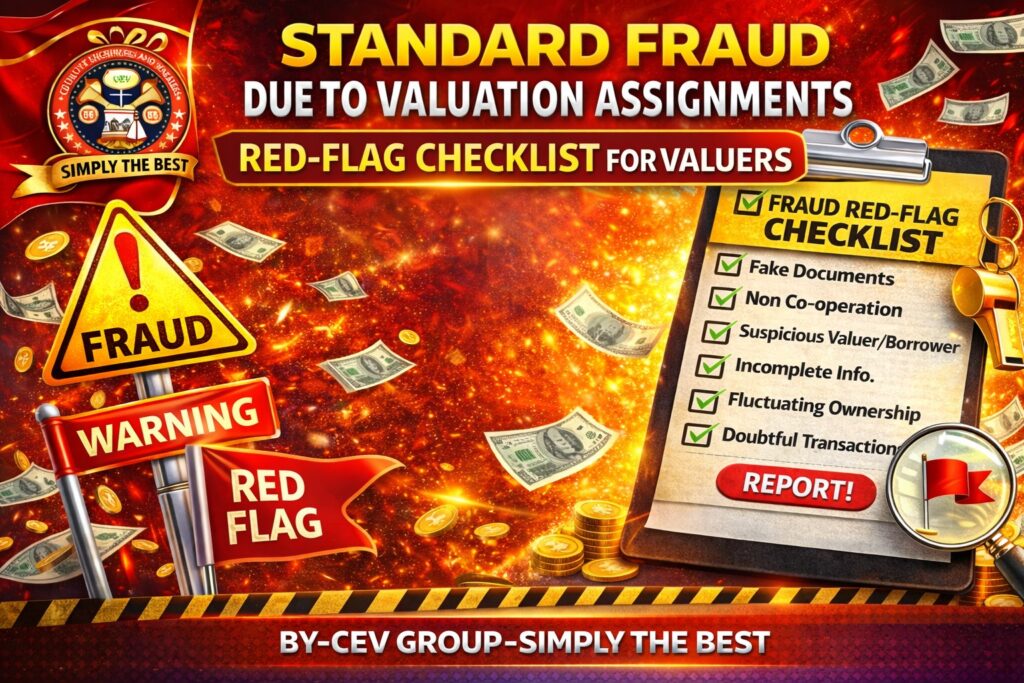

STANDARD FRAUD RED-FLAG CHECKLIST
For Land & Building Valuation Assignments (Banking & Financial Institutions)
By CEV TECHNO NEWS Special Investigative Desk
Purpose:
To assist Valuers in identifying early warning signals of fraud, misrepresentation, collusion, or financial manipulation in property-backed lending cases.
A. Title & Legal Documentation Red Flags
☐ Title deed recently transferred at unusually high appreciation (within 6–12 months).
☐ Multiple recent ownership changes without commercial justification.
☐ Inconsistency between sale deed value and prevailing market rates.
☐ Encumbrance Certificate showing unexplained gaps.
☐ Photocopies provided instead of original title documents for verification.
☐ Alterations, overwriting, or mismatched signatures in legal documents.
☐ Power of Attorney used in high-value transactions without clear rationale.
☐ Property subject to litigation, acquisition notices, or zoning disputes.
Action: Seek legal clarification; inform lender in writing; avoid assumption-based valuation.
B. Physical Inspection Red Flags
☐ Borrower or intermediary insists on restricted site inspection.
☐ Access to certain floors/areas denied.
☐ Property condition materially different from documents provided.
☐ Construction stage misrepresented (e.g., foundation shown as complete structure).
☐ Boundary discrepancies between site and layout plan.
☐ Encroachment visible but not disclosed in records.
☐ Neighbours unaware of ownership claimed by borrower.
☐ Same property photographed earlier in another valuation file.
Action: Record geo-tagged photographs, mention discrepancies explicitly in report.
C. Market & Comparable Data Red Flags
☐ Comparables provided only by broker/borrower (no independent verification).
☐ Identical comparable sales repeatedly used across unrelated files.
☐ Rapid and unjustified price escalation in short time span.
☐ Sale consideration significantly above circle rate without supporting evidence.
☐ Lack of transaction evidence for quoted comparables.
☐ Abnormally high rental yield projections.
Action: Use independent data sources; disclose data limitations clearly.
D. Borrower & Transaction Behaviour Red Flags
☐ Borrower unusually focused on achieving specific valuation figure.
☐ Pressure to “adjust” valuation to meet loan eligibility.
☐ Request for pre-dated or post-dated valuation report.
☐ Third party offering incentives or informal compensation.
☐ Inconsistent statements between borrower and broker.
☐ Multiple loan applications in different banks for same property (suspected).
Action: Immediately document communication; inform lender of undue influence.
E. Multiple Financing & Collateral Risk Indicators
☐ Evidence of prior mortgage not disclosed.
☐ CERSAI / registry search inconsistencies.
☐ Same property ID appearing in earlier valuation assignments.
☐ Loan amount disproportionate to borrower’s financial capacity.
☐ Property previously valued at significantly lower figure without justification.
Action: Advise lender to verify central registry records before disbursement.
F. Builder / Project Level Red Flags
☐ Project approvals incomplete or conditional.
☐ Layout plan differs from actual construction.
☐ Large inventory unsold despite claimed high demand.
☐ Developer previously linked to delayed or stalled projects.
☐ Amenities shown in brochure but not executed on site.
Action: Clearly state approval status and project risks in report.
G. Internal Ethical Red Flags (Self-Check for Valuers)
☐ Conflict of interest (personal, financial, relational).
☐ Repeat assignments for same borrower group without rotation.
☐ Dependence on single bank/broker for majority of work.
☐ Pressure to omit adverse remarks in valuation report.
☐ Lack of adequate time allocated for inspection and research.
Action: Declare conflict; consider declining assignment if independence compromised.
Mandatory Documentation Protocol
✔ Geo-tagged & timestamped site photographs
✔ Site sketch with boundary verification
✔ Independent comparable analysis
✔ Disclosure of assumptions & limiting conditions
✔ Conflict of interest declaration
✔ Market justification narrative
✔ Verification of encumbrances & statutory approvals
Escalation Framework
If material fraud suspicion arises:
-
Record factual observations only (avoid accusations).
-
Submit written clarification request to lender.
-
Preserve inspection evidence securely.
-
Inform RVO ethics committee if professional misconduct is suspected.
Where applicable, serious fraud cases may ultimately be investigated by agencies such as the Central Bureau of Investigation or the Enforcement Directorate under provisions including the Prevention of Money Laundering Act.
Golden Principle for Valuers
“When in doubt, disclose. When pressured, document. When compromised, withdraw.”
Key Notes
A valuer’s strongest protection against fraud allegations is transparency, independence, documentation, and ethical firmness.
This checklist is recommended for adoption by Registered Valuer Organisations (RVOs) and inclusion in mandatory Continuing Professional Education modules.
Published by: Council of Engineers and Valuers (CEV)

https://youtu.be/XRCXR4aw6Bo?si=IKuK_L6VnaJnl-43