
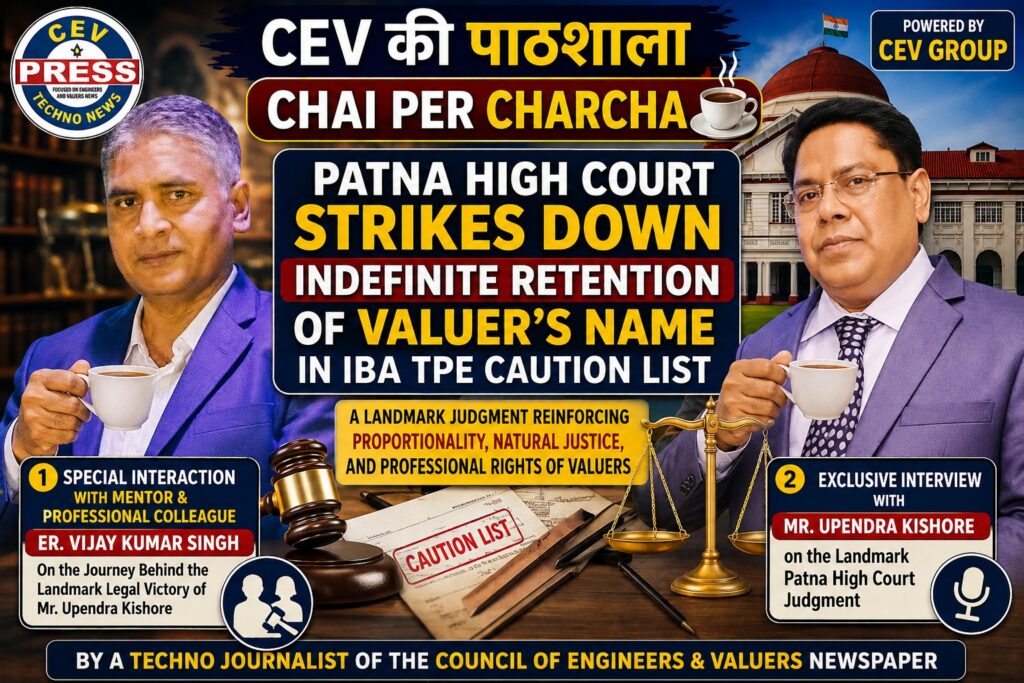

PATNA HIGH COURT STRIKES DOWN INDEFINITE RETENTION OF VALUER’S NAME IN IBA TPE CAUTION LIST
A Landmark Judgment Reinforcing Proportionality, Natural Justice, and Professional Rights of Valuers
In a significant and far-reaching judgment for the valuation fraternity across India, the Patna High Court has delivered a landmark ruling in Upendra Kishore vs. Punjab National Bank & Others [CWJC No. 4131 of 2025], decisively holding that indefinite continuation of a valuer’s name in the Indian Banks’ Association (IBA) TPE Caution List beyond the prescribed maximum period amounts to unconstitutional administrative blacklisting and violates the fundamental rights guaranteed under Articles 14, 19(1)(g), and 21 of the Constitution of India.
The judgment, delivered on 15 May 2026 by Hon’ble Mr. Justice A. Abhishek Reddy, is expected to have a transformative impact on the banking valuation ecosystem, empanelment practices of banks, and the future interpretation of disciplinary measures against valuers.
Background of the Dispute
The petitioner, Mr. Upendra Kishore, was a registered valuer under Section 34AB of the erstwhile Wealth Tax Act, 1957 and had been empanelled with Punjab National Bank since 2005. He is also associated with and stated to be a member of the reputed professional body, The Council of Engineers & Valuers, an organisation known for promoting professional standards, technical excellence, and ethical practices among engineers and valuers across the country.
The dispute originated from a loan transaction involving M/s Priyadarshi Commercial Pvt. Ltd., to whom a credit facility of ₹400 lakhs had been sanctioned by the bank in 2015. The account subsequently turned into an NPA, and a CBI case was registered in 2017 concerning allegations of fraudulent mortgage transactions. Although the petitioner was not named in the FIR or the first chargesheet, his name subsequently appeared in the second chargesheet.
Following this development, Punjab National Bank issued a show-cause notice to the valuer in August 2019, alleging valuation lapses. Despite submission of a written explanation, the bank proceeded to de-empanel him on 18 September 2019, and shortly thereafter, his name was placed in the IBA TPE Caution List on 4 October 2019.
The petitioner argued before the Court that the continued retention of his name in the caution list had effectively resulted in a complete denial of professional opportunities, as most nationalised banks refused to assign valuation work to professionals whose names appeared on the IBA caution list.
The Central Legal Question
The principal issue before the Court was whether a valuer’s name could remain indefinitely in the IBA TPE Caution List even after expiry of the maximum period of de-empanelment prescribed under the governing valuation guidelines.
The petitioner strongly relied upon Clause 1.4 of the “Handbook on Policy Standards and Procedures for Real Estate Valuation by Banks and Housing Finance Institutions in India,” which prescribes removal from the panel for a maximum period of five years even in extreme cases.
Since the de-empanelment order was issued on 18 September 2019, the petitioner contended that the punitive period had legally expired in September 2024 and that continuation of his name in the caution list beyond this period amounted to perpetual blacklisting without authority of law.
Court’s Observations on Administrative Blacklisting
The High Court made several profound observations that are likely to become guiding principles in future disputes involving valuers and professional blacklisting.
The Court drew a clear distinction between legitimate disciplinary regulation and unconstitutional “civil death.” It categorically observed that administrative blacklisting cannot continue perpetually and must remain proportionate and time-bound.
Relying upon important Supreme Court precedents, including:
- Kulja Industries Ltd. v. BSNL
- Vetindia Pharmaceuticals Ltd. v. State of U.P.
- Daffodills Pharmaceuticals Ltd. v. State of U.P.
- Raghunath Thakur v. State of Bihar
- State of Orissa v. Binapani Dei
The Court reiterated that blacklisting orders with severe civil consequences cannot be indefinite and must conform to the constitutional principles of fairness, proportionality, and natural justice.
The Court further held that indefinite continuation of a valuer’s name in a centralised caution list results in deprivation of livelihood and professional reputation, thereby directly affecting the constitutional freedom to practice a profession under Article 19(1)(g).
Fresh Cause of Action Recognised
One of the noteworthy legal aspects of the judgment is the Court’s rejection of the bank’s argument that the matter had already attained finality because earlier proceedings challenging the de-empanelment had been dismissed.
The Court clarified that the petitioner was not challenging the original de-empanelment order afresh; instead, the new cause of action arose from the expiry of the five-year punitive ceiling prescribed under the governing handbook.
This distinction is extremely important because it recognises that administrative penalties cannot automatically continue forever merely because the original disciplinary action once survived judicial scrutiny.
Significance of the Court’s View on Criminal Proceedings
Another crucial dimension of the judgment relates to the Court’s treatment of pending criminal proceedings against valuers.
The High Court took judicial note of the fact that criminal proceedings against the petitioner in the CBI case had already been stayed by a coordinate Bench of the same Court.
Importantly, the Court observed that valuers cannot be routinely prosecuted merely for rendering valuation opinions and that when criminal liability itself is under judicial suspension, continuous administrative punishment based on the same allegations becomes arbitrary and disproportionate.
This observation may provide substantial persuasive value in future litigation involving professional liability of valuers in banking and insolvency matters.
Final Directions Issued by the High Court
Allowing the writ petition, the High Court issued the following important directions:
- The Indian Banks’ Association was directed to immediately remove the petitioner’s name from the TPE Caution List.
- Punjab National Bank was directed to formally communicate the Court’s order to the IBA.
- The bank was directed to independently consider any fresh application for re-empanelment strictly on present eligibility criteria and without being influenced by the expired 2019 de-empanelment.
However, the Court clarified that its observations were confined to administrative blacklisting and would not affect the pending criminal trial, which would continue independently in accordance with law.
Wider Implications for the Valuation Profession
This judgment carries enormous implications for registered valuers, bank empanelment systems, and regulatory authorities throughout India.
1. End of Indefinite Caution Listing
The ruling strongly indicates that indefinite continuation in IBA caution lists without a specified tenure may not withstand constitutional scrutiny.
2. Reinforcement of Proportionality Doctrine
The judgment reinforces the principle that disciplinary action must remain proportionate to the alleged misconduct and cannot operate as lifelong professional exclusion.
3. Importance of Natural Justice
The Court emphasized that inclusion in caution lists affecting livelihood and professional reputation must comply with principles of natural justice, including notice and opportunity of hearing.
4. Need for Transparent Banking Policies
Banks and financial institutions may now be compelled to revisit their empanelment and de-empanelment frameworks to ensure clear timelines, review mechanisms, and procedural safeguards.
5. Relief for Numerous Affected Valuers
Many valuers whose names continue indefinitely in caution or blacklisting databases despite expiry of punitive periods may now seek judicial remedies based on this precedent.
Final Words
The Patna High Court’s judgment represents a major constitutional and professional milestone for the valuation sector in India. By recognising that indefinite professional exclusion amounts to “civil death,” the Court has reaffirmed that even administrative discretion exercised by banks and industry associations must remain subject to fairness, proportionality, and constitutional discipline.
The fact that the petitioner is associated with The Council of Engineers & Valuers also highlights the broader concern within professional circles regarding fair treatment, due process, and protection of the livelihood of qualified valuers functioning within the banking and financial ecosystem.
For the valuation profession, the decision sends a powerful message that disciplinary mechanisms cannot become instruments of perpetual professional extinction. Regulatory actions must be balanced, time-bound, transparent, and legally sustainable.
At a time when valuers increasingly face heightened scrutiny in banking, insolvency, and financial transactions, this ruling may emerge as one of the most important judicial pronouncements safeguarding professional rights and due process within the Indian valuation framework.
VIEW FULL VIDEO
विशेष साक्षात्कार
ऐतिहासिक न्यायिक विजय के बाद श्री उपेन्द्र किशोर से विशेष बातचीत
इंजीनियर्स एवं वैल्यूअर्स के प्रमुख समाचार पत्र के टेक्नो पत्रकार द्वारा
प्रश्न 1. सबसे पहले आपको इस ऐतिहासिक जीत की बहुत-बहुत बधाई। आप Patna High Court के इस निर्णय को व्यक्तिगत रूप से कैसे देखते हैं?
उत्तर – श्री उपेन्द्र किशोर:
बहुत-बहुत धन्यवाद। मैं इस निर्णय को केवल अपनी व्यक्तिगत जीत नहीं मानता, बल्कि पूरे देश के वैल्यूअर्स समुदाय की जीत मानता हूँ। माननीय न्यायालय ने यह स्पष्ट किया है कि किसी भी पेशेवर व्यक्ति को बिना निश्चित समय सीमा के अनिश्चितकाल तक दंडित नहीं किया जा सकता। यह निर्णय संविधान द्वारा दिए गए पेशेवर सम्मान और आजीविका के अधिकार को मजबूत करता है।
प्रश्न 2. आपका नाम IBA TPE Caution List में आने के बाद आपको सबसे बड़ी कठिनाई क्या झेलनी पड़ी?
उत्तर – श्री उपेन्द्र किशोर:
सबसे बड़ी समस्या यह थी कि मेरे पेशेवर कार्य लगभग बंद हो गए। अधिकांश राष्ट्रीयकृत बैंकों ने मुझे वैल्यूएशन कार्य देना बंद कर दिया। किसी भी वैल्यूअर के लिए बैंक पैनल पर बने रहना आजीविका का महत्वपूर्ण माध्यम होता है। इस सूची में नाम बने रहने से मेरी पेशेवर प्रतिष्ठा और भविष्य दोनों प्रभावित हुए।
प्रश्न 3. न्यायालय ने अपने निर्णय में “Civil Death” शब्द का उपयोग किया है। वैल्यूअर्स के लिए यह टिप्पणी कितनी महत्वपूर्ण है?
उत्तर – श्री उपेन्द्र किशोर:
यह टिप्पणी अत्यंत महत्वपूर्ण है। न्यायालय ने यह समझा कि यदि किसी पेशेवर को अनिश्चितकाल तक ब्लैकलिस्ट रखा जाए तो उसका पूरा करियर समाप्त हो सकता है। एक वैल्यूअर वर्षों की मेहनत से अपनी प्रतिष्ठा और विश्वास बनाता है। ऐसे में अनिश्चितकालीन ब्लैकलिस्टिंग वास्तव में पेशेवर जीवन समाप्त करने जैसी स्थिति बन जाती है।
प्रश्न 4. इस निर्णय में “Proportionality” और समयबद्ध दंड पर विशेष जोर दिया गया है। इससे बैंकों और नियामक संस्थाओं को क्या संदेश जाता है?
उत्तर – श्री उपेन्द्र किशोर:
यह निर्णय स्पष्ट संदेश देता है कि अनुशासनात्मक कार्रवाई निष्पक्ष, पारदर्शी और समय-सीमित होनी चाहिए। कोई भी दंड अनंतकाल तक नहीं चल सकता। IBA की अपनी गाइडलाइन में अधिकतम पाँच वर्ष की अवधि निर्धारित थी। उसके बाद भी मेरा नाम सूची में बनाए रखना मनमाना और असंवैधानिक था।
प्रश्न 5. The Council of Engineers & Valuers जैसे प्रतिष्ठित संगठन से जुड़े होने के नाते, आप पेशेवर संगठनों की भूमिका को कैसे देखते हैं?
उत्तर – श्री उपेन्द्र किशोर:
ऐसे संगठन पेशेवरों को तकनीकी, नैतिक और कानूनी मार्गदर्शन प्रदान करते हैं। The Council of Engineers & Valuers जैसे संगठन इंजीनियर्स और वैल्यूअर्स के हितों की रक्षा करने और उन्हें जागरूक बनाने में महत्वपूर्ण भूमिका निभाते हैं। कठिन समय में ऐसे संगठनों का नैतिक समर्थन बहुत महत्वपूर्ण होता है।
प्रश्न 6. न्यायालय ने यह भी कहा कि केवल वैल्यूएशन रिपोर्ट देने के कारण वैल्यूअर्स पर सामान्य रूप से आपराधिक मुकदमे नहीं चलाए जा सकते। आप इसे कैसे देखते हैं?
उत्तर – श्री उपेन्द्र किशोर:
यह निर्णय का अत्यंत महत्वपूर्ण हिस्सा है। वैल्यूएशन एक विशेषज्ञ राय होती है जो उपलब्ध दस्तावेजों, बाजार परिस्थितियों और तकनीकी विश्लेषण पर आधारित होती है। यह कोई पूर्ण गणितीय विज्ञान नहीं है। जब तक स्पष्ट रूप से धोखाधड़ी या गलत नीयत साबित न हो, केवल वैल्यूएशन रिपोर्ट देने के आधार पर वैल्यूअर को अपराधी नहीं माना जाना चाहिए।
प्रश्न 7. इस पूरे संघर्ष से युवा वैल्यूअर्स और इंजीनियर्स को क्या सीख लेनी चाहिए?
उत्तर – श्री उपेन्द्र किशोर:
युवा पेशेवरों को हमेशा सही दस्तावेजीकरण, पारदर्शिता, तकनीकी गुणवत्ता और नैतिकता बनाए रखनी चाहिए। हर रिपोर्ट तथ्यों और उचित निरीक्षण पर आधारित होनी चाहिए। साथ ही उन्हें अपने कानूनी और संवैधानिक अधिकारों की जानकारी भी होनी चाहिए।
प्रश्न 8. क्या आपको लगता है कि यह निर्णय अन्य वैल्यूअर्स को भी राहत देगा?
उत्तर – श्री उपेन्द्र किशोर:
बिल्कुल। यह निर्णय एक महत्वपूर्ण कानूनी सिद्धांत स्थापित करता है कि कोई भी प्रशासनिक दंड अनिश्चितकाल तक जारी नहीं रह सकता। इससे उन अनेक वैल्यूअर्स को राहत मिल सकती है जो लंबे समय से ऐसी समस्याओं का सामना कर रहे हैं।
प्रश्न 9. इस निर्णय के बाद आप भारत की बैंकिंग वैल्यूएशन प्रणाली में कौन-से सुधार देखना चाहते हैं?
उत्तर – श्री उपेन्द्र किशोर:
मैं चाहता हूँ कि पूरे देश में वैल्यूअर्स के लिए एक पारदर्शी और समान प्रणाली बने जिसमें पैनल बनाने, हटाने, समीक्षा और अपील की स्पष्ट प्रक्रिया हो। किसी भी कार्रवाई से पहले उचित सुनवाई और स्पष्ट आदेश दिए जाने चाहिए।
प्रश्न 10. अंत में आप वैल्यूअर्स समुदाय और पाठकों को क्या संदेश देना चाहेंगे?
उत्तर – श्री उपेन्द्र किशोर:
मैं सभी वैल्यूअर्स और इंजीनियर्स से कहना चाहता हूँ कि वे हमेशा अपनी पेशेवर ईमानदारी और नैतिकता बनाए रखें। कठिन परिस्थितियाँ जीवन का हिस्सा हैं, लेकिन धैर्य और न्याय व्यवस्था पर विश्वास बनाए रखना बहुत जरूरी है। यह निर्णय साबित करता है कि कानून और संविधान आज भी पेशेवरों के अधिकारों की रक्षा करते हैं।
विशेष संवाद
मार्गदर्शक एवं पेशेवर सहयोगी Er. विजय कुमार सिंह से विशेष बातचीत
ऐतिहासिक कानूनी विजय की पूरी यात्रा पर
प्रश्न 1. आपने इस पूरे कठिन समय में श्री उपेन्द्र किशोर का साथ दिया। यह यात्रा कितनी चुनौतीपूर्ण रही?
उत्तर – Er. विजय कुमार सिंह:
यह समय बहुत कठिन और भावनात्मक रूप से चुनौतीपूर्ण था। किसी वैल्यूअर का नाम caution list में आने का प्रभाव केवल काम तक सीमित नहीं रहता, बल्कि उसकी प्रतिष्ठा, आत्मविश्वास और भविष्य पर भी पड़ता है। मैंने एक मित्र और पेशेवर सहयोगी के रूप में उनके संघर्ष को बहुत करीब से देखा।
प्रश्न 2. आपको इस लंबे कानूनी संघर्ष में उनके साथ खड़े रहने की प्रेरणा कहाँ से मिली?
उत्तर – Er. विजय कुमार सिंह:
पेशेवर एकता और मानवीय मूल्य सबसे बड़ी प्रेरणाएँ थीं। हम जानते हैं कि वैल्यूएशन एक विशेषज्ञ राय होती है और हर रिपोर्ट परिस्थितियों और उपलब्ध तथ्यों पर आधारित होती है। मेरा विश्वास था कि किसी भी पेशेवर को अनिश्चित काल तक दंडित नहीं किया जाना चाहिए।
प्रश्न 3. आपके अनुसार इस निर्णय का सबसे महत्वपूर्ण संदेश क्या है?
उत्तर – Er. विजय कुमार सिंह:
सबसे बड़ा संदेश यह है कि प्रशासनिक कार्रवाई निष्पक्ष, संतुलित और समयबद्ध होनी चाहिए। माननीय न्यायालय ने स्पष्ट कर दिया कि अनिश्चितकालीन ब्लैकलिस्टिंग किसी पेशेवर के पूरे करियर को समाप्त कर सकती है।
प्रश्न 4. इस संघर्ष के दौरान श्री उपेन्द्र किशोर की कौन-सी विशेषता ने आपको सबसे अधिक प्रभावित किया?
उत्तर – Er. विजय कुमार सिंह:
उनका धैर्य, आत्मविश्वास और न्याय व्यवस्था पर भरोसा मुझे सबसे अधिक प्रभावित करता रहा। कठिन परिस्थितियों के बावजूद उन्होंने कभी हार नहीं मानी और हमेशा कानूनी रास्ते से संघर्ष जारी रखा।
प्रश्न 5. अंत में आप युवा वैल्यूअर्स और इंजीनियर्स को क्या संदेश देना चाहेंगे?
उत्तर – Er. विजय कुमार सिंह:
मैं यही कहना चाहूँगा कि हमेशा तकनीकी गुणवत्ता, सही दस्तावेजीकरण, नैतिकता और ईमानदारी बनाए रखें। साथ ही अपने कानूनी अधिकारों के प्रति जागरूक रहें। कठिन समय आने पर घबराने के बजाय धैर्य और एकजुटता बनाए रखें। यही इस पूरे संघर्ष की सबसे बड़ी सीख है।
INTERVIEW
Special Interaction with Mentor & Professional Colleague
5 Exclusive Questions with Er. Vijay Kumar Singh
On the Journey Behind the Landmark Legal Victory of Mr. Upendra Kishore
Q1. Sir, you closely supported Mr. Upendra Kishore throughout this difficult legal and professional journey. How challenging was this entire phase?
Answer – Er. Vijay Kumar Singh:
It was an extremely difficult and emotionally exhausting phase, both professionally and personally. When a valuer’s name appears in a caution list, the impact extends beyond one assignment or one institution — it affects reputation, confidence, livelihood, and professional identity. As a friend and professional colleague, I witnessed the tremendous stress and uncertainty he faced over several years. However, throughout this journey, we remained committed to the belief that fairness, legal principles, and truth would ultimately prevail.
Q2. What motivated you to stand beside Mr. Upendra Kishore during this prolonged legal battle?
Answer – Er. Vijay Kumar Singh:
Professional solidarity and human values were the biggest motivations. In the valuation profession, we understand the complexities and risks associated with professional opinions. A valuer’s report is an expert assessment based on available records, market conditions, and professional judgment. I strongly believed that no professional should suffer perpetual punishment without final adjudication and without proportionality. As colleagues, we must support each other during difficult times, especially when larger professional principles are involved.
Q3. From your perspective, what is the most important takeaway from this judgment for valuers across India?
Answer – Er. Vijay Kumar Singh:
The biggest takeaway is that administrative actions must remain fair, proportionate, and time-bound. The Hon’ble Court has very clearly recognized that indefinite continuation in a caution list can virtually destroy a professional career. This judgment sends a strong message that institutions cannot impose endless professional exclusion beyond their own prescribed guidelines. It is a major reaffirmation of constitutional fairness and professional dignity.
Q4. During this long struggle, what qualities in Mr. Upendra Kishore impressed you the most?
Answer – Er. Vijay Kumar Singh:
His patience, resilience, and faith in the judicial process impressed me immensely. Despite severe professional setbacks and emotional pressure, he remained disciplined and continued fighting through lawful means. Many people lose confidence under such circumstances, but he consistently believed that justice would ultimately prevail. His determination became an inspiration for many professionals who silently face similar hardships.
Q5. Finally, what message would you like to give to young valuers, engineers, and professional colleagues after this landmark victory?
Answer – Er. Vijay Kumar Singh:
My message is very simple — always maintain professional ethics, proper documentation, technical competence, and integrity in your work. At the same time, professionals must remain aware of their legal and constitutional rights. One adverse situation should never break a professional’s confidence. This case teaches us that perseverance, professional unity, and faith in justice are extremely important. The valuation profession plays a critical role in the financial system, and valuers deserve fairness, respect, and due process under law.
Exclusive Interview
10 Questions & Detailed Answers with Mr. Upendra Kishore on the Landmark Patna High Court Judgment
By a Techno Journalist of The Council of Engineers & Valuers Newspaper
Q1. Sir, first of all congratulations on this landmark victory. How do you personally view this judgment delivered by the Patna High Court?
Answer – Mr. Upendra Kishore:
Thank you very much. I consider this judgment not merely a personal victory but a victory for the entire fraternity of valuers across India. The Hon’ble Court has recognized that no professional can be subjected to indefinite administrative punishment without a clear legal basis or prescribed timeline. The judgment restores faith in constitutional fairness and reinforces that valuers too have professional dignity and livelihood rights protected under the Constitution of India.
Q2. What was the biggest hardship you faced after your name was included in the IBA TPE Caution List?
Answer – Mr. Upendra Kishore:
The inclusion of my name in the caution list practically paralysed my professional career. Most banks became reluctant to assign valuation work despite there being no final judicial finding against me. For a professional valuer, empanelment with banks is a major source of livelihood. The continuation of the caution listing created professional isolation and reputational damage. It was almost like a silent blacklisting operating throughout the banking system.
Q3. The Court has repeatedly used the expression “civil death.” How important is this observation for professionals like valuers?
Answer – Mr. Upendra Kishore:
This observation is extremely significant. The Hon’ble Court correctly understood that indefinite blacklisting destroys a professional’s economic survival, reputation, and future opportunities. A valuer spends decades building credibility, technical competence, and trust. If a caution list becomes perpetual, it effectively ends the person’s professional existence. By using the phrase “civil death,” the Court highlighted the severe consequences of indefinite administrative actions.
Q4. The judgment places heavy emphasis on proportionality and time-bound punishment. What message does this send to banks and regulatory bodies?
Answer – Mr. Upendra Kishore:
The message is very clear: disciplinary mechanisms must be fair, transparent, and proportionate. Punishment cannot continue endlessly. Even the IBA handbook itself prescribed a maximum period of five years. Once that period expired, continuation of my name in the caution list became arbitrary. The judgment reminds all institutions that administrative discretion cannot override constitutional protections.
Q5. As a member associated with The Council of Engineers & Valuers, what role do professional organizations play in protecting valuers?
Answer – Mr. Upendra Kishore:
Professional organizations play a very important role in maintaining technical standards, promoting ethics, and supporting professionals during difficult situations. Organizations like The Council of Engineers & Valuers provide intellectual, technical, and moral strength to valuers. They also create awareness regarding legal rights, professional obligations, and evolving regulatory frameworks. Collective professional representation becomes extremely important in matters affecting the dignity and independence of valuers.
Q6. The Court also observed that valuers cannot be routinely prosecuted merely for rendering valuation opinions. How do you interpret this observation?
Answer – Mr. Upendra Kishore:
This is one of the most important observations in the judgment. Valuation is fundamentally an expert professional opinion based upon available records, market conditions, technical assessment, and professional judgment. It is not an exact science. Unless there is clear evidence of mala fide intention, fraud, or deliberate misconduct, valuers should not automatically be criminalized merely because a borrower later defaults or a financial transaction becomes disputed. This distinction is essential for preserving professional independence.
Q7. What lessons should young valuers and engineering professionals learn from this entire episode?
Answer – Mr. Upendra Kishore:
Young professionals must understand the importance of documentation, ethics, transparency, and adherence to professional standards. Every valuation report should be technically sound, properly reasoned, and supported by records and field verification. At the same time, professionals should also be aware of their constitutional and legal rights. Fear should not replace professional judgment. Integrity and competence remain the strongest safeguards.
Q8. Do you believe this judgment may help other valuers facing similar caution-list or blacklisting issues?
Answer – Mr. Upendra Kishore:
Certainly. This judgment establishes a very important legal principle that administrative penalties cannot continue indefinitely beyond the prescribed period. Many professionals across India may have been facing similar difficulties. The ruling provides judicial clarity that caution lists and debarments must remain legally sustainable, proportionate, and time-bound. I believe this decision will encourage fairer treatment of valuers within the banking ecosystem.
Q9. After this judgment, what reforms would you like to see in the banking valuation system in India?
Answer – Mr. Upendra Kishore:
There is a need for a transparent and uniform national framework regarding empanelment, disciplinary proceedings, review mechanisms, and appeal systems for valuers. Any adverse action should include proper notice, hearing, speaking orders, and clearly defined timelines. There should also be periodic review of caution listings so that professionals are not subjected to endless punishment. Banks and valuers should function as professional stakeholders rather than adversaries.
Q10. Finally, what message would you like to give to the valuation fraternity and readers of the newspaper?
Answer – Mr. Upendra Kishore:
I would like to tell fellow valuers and engineers that professionalism, patience, and faith in the legal system are extremely important. Difficult situations may arise, but one must continue to uphold ethics and professional integrity. This judgment demonstrates that constitutional protections still remain available to professionals who seek justice lawfully. I hope this decision strengthens confidence among valuers and contributes toward a more balanced and fair professional environment in India.
Published by: Council of Engineers and Valuers (CEV)
ALL COURT CASES DECISIONS COMPILED IN A FOLDER


KEY ASPECTS RELATING TO VALUERS