
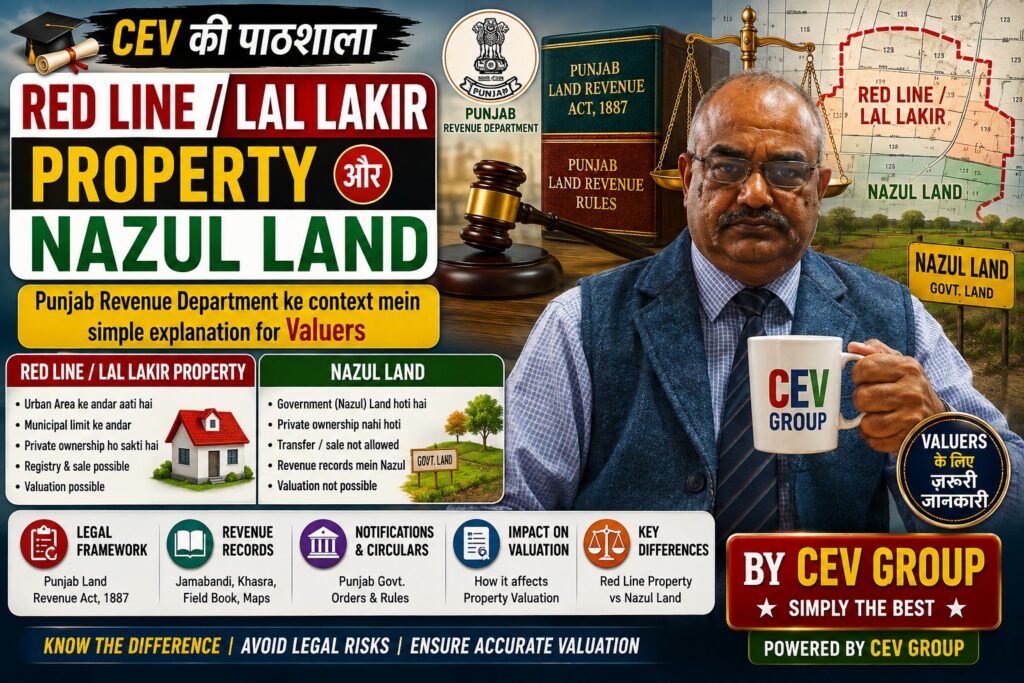


In the Punjab revenue-record context, “Red Line Property” (Lal Lakir/Lal Dora property) and Nazul Land are two completely different concepts. They are often confused because both can involve properties where ordinary ownership/revenue records may be different from conventional agricultural land records.
I have checked the Punjab statutory material, including the Punjab Abadi Deh (Record of Rights) Act, 2021 and the Nazul Lands (Transfer) Rules, 1956.
1. What is “Red Line” / Lal Lakir Property?
In Punjab, the Red Line / Lal Lakir generally refers to the area of a village traditionally identified as the Abadi Deh, i.e. the inhabited/residential portion of the village, which was demarcated from the agricultural/revenue-paying area by a red line in the revenue settlement/map.
Historically, the red line separated the village habitation area from the surrounding agricultural land. The concept dates back to the revenue-survey system and is commonly referred to as Lal Lakir or Lal Dora.
Important point
“Red Line” is primarily a description of the LOCATION/CLASSIFICATION of the land in relation to the village Abadi Deh.
It does not automatically mean that the Government is the owner of the property.
That is the first and most important distinction from Nazul land.
The Punjab legislature subsequently enacted the Punjab Abadi Deh (Record of Rights) Act, 2021, specifically because Abadi Deh areas historically lacked proper recording of proprietors’ rights, preparation of records and systematic demarcation. The Act provides a statutory mechanism for identifying, recording and resolving proprietary rights in Abadi Deh areas.
2. What is Nazul Land?
Nazul land is fundamentally Government land.
The expression has a different legal origin and character from Lal Lakir/Abadi Deh.
Under the Punjab Nazul Lands (Transfer) Rules, 1956, “Nazul land” is defined, among other things, as land situated beyond the specified municipal limits which has escheated to the State Government and has not already been appropriated by the State Government, together with such other land as the State Government may make available for transfer under the Rules.
The Rules also specifically deal with Nazul houses and house sites, showing that Nazul status is not confined merely to vacant agricultural land.
Therefore, in practical revenue terminology:
Nazul Land = land belonging to / vested in the Government and administered under the applicable Nazul rules/policies.
The precise legal history of a particular Nazul parcel must, however, be established from the relevant revenue record, Nazul register, allotment/lease order, government notification and other title documents.
3. The Fundamental Difference
The easiest way to remember the distinction is:
RED LINE = WHERE THE PROPERTY IS
NAZUL = WHO OWNS THE PROPERTY
A property can fall inside the Lal Lakir/Abadi Deh without being Nazul land.
Conversely, Nazul land may exist outside a village’s traditional Lal Lakir, depending upon its particular history and classification.
4. Detailed Comparison
| Particular | Red Line / Lal Lakir / Abadi Deh | Nazul Land |
|---|---|---|
| Basic concept | Village habitation/Abadi area | Government land |
| Main significance | Geographical/revenue classification | Ownership/title character |
| Historical basis | Revenue settlement and demarcation of village habitation | Government vesting/escheat and other Government land |
| Does it automatically mean Government ownership? | No | Generally Yes, subject to the applicable record and legal history |
| Typical location | Inside village habitation | May be within/near urban or rural areas depending on its source and applicable rules |
| Agricultural land? | Generally associated with habitation rather than agricultural area | Can have different historical land uses |
| Private ownership possible? | Yes | Direct freehold private ownership is not presumed merely from possession |
| Private house possible? | Yes | Yes, but the underlying Government/Nazul title must be examined |
| Normal ownership document | Depending on circumstances, Abadi Deh record/property rights, registered documents, old documents etc. | Government allotment/lease/patta/freehold/conversion document, revenue record etc. |
| Sale by occupant | Depends upon legally established ownership/right | Usually subject to Government/Nazul conditions and permissions |
| Transfer restrictions | Depend on nature of recorded rights and applicable law | Frequently subject to lease/allotment conditions and Government permission |
| Revenue record | Historically deficient in many Abadi Deh areas; 2021 Act addresses this | Government/Nazul classification and relevant Government records are critical |
| Main legal concern | Establishing/recording proprietary rights | Establishing the Government’s title and the occupant’s legal interest |
| Can possession alone establish ownership? | Not necessarily | Definitely not merely because of possession |
| Valuation implication | Title/recording of Abadi Deh rights must be examined | Government title, leasehold/freehold status, tenure and transfer restrictions are critical |
5. Why the confusion occurs
Suppose there is an old house in a Punjab village.
The property is inside the red line.
A person may say:
“This is Lal Lakir property, therefore it is Government property.”
That conclusion is wrong.
The red line principally identifies the Abadi Deh/habitation area. It does not, by itself, determine that the entire land inside it belongs to the Government.
The 2021 Punjab Act itself recognises that the historical problem was that Abadi Deh areas had remained without proper recording of the rights of proprietors and without systematic survey/demarcation.
6. Example — Red Line Property
Imagine:
Village ABC
Revenue map:
              AGRICULTURAL LAND
        -----------------------------
        |                           |
        |       LAL LAKIR           |
        |      / RED LINE           |
        |    ______________         |
        |   |              |        |
        |   |  Houses      |        |
        |   |  Shops       |        |
        |   |  Streets     |        |
        |   |______________|        |
        |                           |
        -----------------------------
The area inside the red boundary represents the traditional Abadi Deh.
Suppose House No. 25 has been possessed by the same family for several generations.
That fact alone does not answer the question:
“Who legally owns House No. 25?”
For that, one must examine the applicable Abadi Deh record, documents, survey/property record, succession, registered instruments and other evidence.
The Punjab Abadi Deh Act, 2021 was enacted precisely to create a mechanism for recording and resolving such proprietary rights.
7. Example — Nazul Land
Suppose a parcel is recorded as:
Owner: Government
Classification: Nazul
The Government subsequently grants a person a lease over the property.
The person may:
- possess the property;
- construct a building;
- pay lease rent;
- pay property tax;
- have electricity/water connections;
- even have a registered document relating to the lease.
But these facts do not automatically convert the underlying Government land into privately owned freehold land.
The legal rights of the occupant will depend upon the lease/allotment/patta/conveyance and the applicable Nazul rules/policy.
This is particularly important because the Punjab Nazul Rules contain restrictions on alienation in specified circumstances. For example, Rule 7 imposes restrictions on alienation of Nazul land transferred under those Rules.
8. A Very Important Valuation Distinction
For a Registered Valuer, the distinction becomes extremely important.
In Lal Lakir / Abadi Deh property, the key question is:
“What is the legally established proprietary right of the person occupying/claiming the property?”
In Nazul property, the key questions are:
“Who owns the land?”
and
“What legal interest has been granted to the occupant?”
For example:
Government → Nazul land → Lease granted to A
A may have a valuable leasehold interest, but that does not necessarily mean A owns the underlying land.
Therefore, the valuer must not simply value the property as freehold land merely because there is a building standing on it.
9. Red Line Does NOT Mean “No Registry”
This is another common misconception.
Historically, registration of transactions involving Lal Lakir properties could become problematic because of inadequate proof of title. There were instances where the Revenue Department questioned registration where ownership could not be established.
But the legal position should not be reduced to:
“Red Line = No Registry.”
The current framework has changed substantially because of the Punjab Abadi Deh (Record of Rights) Act, 2021, including mechanisms for survey, identification and recording of rights. The Act’s stated purpose is specifically to provide recording and resolution of proprietary rights in Abadi Deh areas.
Therefore, for a current transaction, one should examine the actual latest revenue/property record and applicable registration requirements, rather than relying upon an old general statement about Lal Lakir properties.
10. Can Red Line and Nazul overlap?
Potentially, yes.
This is a very important point.
“Lal Lakir” and “Nazul” describe different legal/revenue characteristics.
For example, an area may be within an inhabited area, but a particular parcel inside that area could have a separate Government/Nazul history.
Therefore:
Do not determine ownership merely from the fact that a property is inside or outside the red line.
Similarly:
Do not determine Nazul status merely from the physical appearance or location of the property.
The revenue record and original title history must be examined.
11. Documents that should be checked
For a professional valuation/title examination, I would recommend checking the following.
A. For Red Line / Abadi Deh property
- Latest Abadi Deh Record of Rights
- Survey/property card, wherever prepared
- Relevant revenue map / Lal Lakir map
- Previous ownership documents
- Registered sale deeds
- Gift/relinquishment/partition documents
- Succession documents
- Mutation entries
- Possession/occupancy evidence
- Relevant proceedings under the Punjab Abadi Deh Act, 2021
- Demarcation/survey record
- Encumbrance/litigation information
- Building/municipal records, where applicable
The 2021 Act specifically provides for identification, recording and resolution of proprietary rights and demarcation of survey units in Abadi Deh.
B. For Nazul property
The examination should additionally focus on:
- Nazul register
- Government ownership entry
- Original Nazul allotment
- Lease deed/patta
- Government sanction/order
- Renewal of lease
- Ground rent/lease rent
- Conversion/freehold order, if any
- Permission for transfer
- Permission for mortgage
- Restrictions on alienation
- Re-entry/resumption provisions
- Encroachment/regularisation orders
- Government NOC, where applicable
- Latest revenue record
- Development authority/municipal records, where relevant
12. Effect on Market Value
This distinction can have a major impact on valuation.
Consider two apparently identical houses:
Property A
- 250 sq. yd.
- Within Lal Lakir
- Proprietary right properly established
- Transfer legally permissible
- No Government restriction
Property B
- 250 sq. yd.
- Government/Nazul land
- Occupant has only a leasehold interest
- Transfer requires Government permission
- Lease has restrictions
Even though both houses may look identical physically, their legal interests are not identical.
Consequently, their market values need not be identical.
A valuer should therefore distinguish between:
Value of the physical property
and
Value of the legally transferable interest in the property.
13. The Most Important Rule for Valuers
I would suggest that every valuation report involving such property should avoid simply writing:
“Property is situated in Lal Lakir.”
or
“Property is Nazul.”
That is not sufficient.
Instead, the report should identify:
(a) the exact revenue classification;
(b) recorded owner;
(c) nature of claimant’s right;
(d) whether freehold or leasehold;
(e) source/document establishing the right;
(f) restrictions on transfer;
(g) Government permission/NOC requirements;
(h) whether the property is transferable/mortgageable;
(i) whether any regularisation/conversion is pending; and
(j) whether the value reported represents the freehold interest, leasehold interest, possessory interest, or another legally recognised interest.
14. One-line distinction for examination purposes
RED LINE / LAL LAKIR
A revenue demarcation identifying the traditional inhabited/Abadi Deh portion of a village; it does not, by itself, establish Government ownership.
NAZUL LAND
Government land falling within the applicable Nazul regime, the occupation or transfer of which is governed by the relevant Government records, allotment/lease conditions and applicable Nazul rules/policies.
Therefore:
Lal Lakir answers primarily “WHERE is the property?” whereas Nazul answers primarily “WHAT IS THE GOVERNMENT’S TITLE/INTEREST IN THE LAND?”
The statutory framework is especially important because Punjab’s Abadi Deh Act, 2021 deals with recording proprietary rights in habitation areas, whereas the Nazul Lands (Transfer) Rules, 1956 deal with a category of Government land and its transfer/administration.
One caution: “Nazul” terminology and its exact legal consequences can vary across States and historical revenue systems. The above distinction is specifically framed for Punjab based on the Punjab statutory/revenue framework.
RED LINE / LAL LAKIR PROPERTY AUR NAZUL LAND
Punjab Revenue Department ke context mein simple explanation for Valuers
Punjab mein Red Line Property (Lal Lakir/Lal Dora Property) aur Nazul Land ko aksar ek hi samjha jata hai, lekin dono ka legal concept bilkul different hai.
Ek simple rule yaad rakhiye:
RED LINE primarily batati hai ki property WHERE situated hai.
NAZUL primarily batata hai ki land ka Government ke saath kya ownership/title relationship hai.
Is difference ko samajhna ek Registered Valuer ke liye bahut important hai.
1. RED LINE / LAL LAKIR PROPERTY KYA HOTI HAI?
Punjab ke traditional Revenue Records mein village ke inhabited/residential area ko generally Abadi Deh kaha jata hai.
Is Abadi Deh area ko historically surrounding agricultural land se ek Red Line, yani Lal Lakir, ke through demarcate kiya jata tha.
Simple language mein:
Lal Lakir village ke us inhabited area ko identify karti hai jahan traditionally houses, streets, shops aur other residential structures hote hain.
Yeh agricultural fields se village habitation ko separate karne ka traditional revenue arrangement tha.
Sabse important baat:
Lal Lakir ka matlab automatically Government Property nahi hota.
Yeh ek bahut common misconception hai.
Agar koi property Lal Lakir ke andar hai, iska matlab yeh nahi hai ki:
“Yeh Government ki property hai.”
Property ka actual ownership/right alag documents aur revenue records se determine hoga.
Punjab mein Punjab Abadi Deh (Record of Rights) Act, 2021 bhi isi issue se connected hai, kyunki Abadi Deh areas mein historically ownership/proprietary rights ki proper recording ek major issue rahi hai.
2. SIMPLE EXAMPLE OF RED LINE PROPERTY
Maan lijiye ek village hai:
Village ABC
Village ke bahar agricultural land hai aur beech mein houses ka ek old habitation area hai.
Revenue map mein habitation area ko ek red boundary se mark kiya gaya.
          AGRICULTURAL LAND
   -------------------------------
   |                             |
   |       LAL LAKIR             |
   |     / ABADI DEH             |
   |    ______________           |
   |   |              |          |
   |   |   Houses     |          |
   |   |   Shops      |          |
   |   |   Streets    |          |
   |   |______________|          |
   |                             |
   -------------------------------
Is red boundary ke andar ki land ko generally Abadi Deh/Lal Lakir area kaha ja sakta hai.
Ab maan lijiye ek house 50 saal se ek family ke possession mein hai.
Isse yeh automatically prove nahi hota ki family ke paas absolute freehold ownership hai.
Valuer ko actual documents aur revenue/property records examine karne honge.
3. PUNJAB ABADI DEH ACT, 2021 KA IMPORTANCE
Punjab Government ne Punjab Abadi Deh (Record of Rights) Act, 2021 banaya, jiska basic purpose Abadi Deh areas mein:
- proprietary rights ko identify karna,
- rights ko record karna,
- survey/demarcation karna,
- Record of Rights prepare karna,
- aur ownership-related disputes ko resolve karne ka mechanism provide karna
hai.
Isliye aaj ke time mein sirf yeh keh dena ki:
“Property Lal Lakir mein hai.”
sufficient title conclusion nahi hai.
Valuer ko dekhna hoga ki latest available record mein right kis person ke naam hai aur us right ki legal nature kya hai.
4. NAZUL LAND KYA HOTI HAI?
Ab aate hain Nazul Land par.
Nazul Land ka concept Lal Lakir se completely different hai.
Simple language mein:
Nazul Land generally Government land hoti hai jo applicable Nazul rules/policies ke under Government ke control/administration mein hoti hai.
Punjab mein Punjab Nazul Lands (Transfer) Rules, 1956 relevant framework provide karte hain.
Nazul land ka historical source alag ho sakta hai, including Government mein vesting/escheat etc., aur particular property ke liye exact status revenue records aur Government documents se verify karna chahiye.
5. NAZUL PROPERTY KA SIMPLE EXAMPLE
Maan lijiye ek plot Government ke naam hai aur woh Nazul Land ke roop mein recorded hai.
Government ne woh plot kisi person ko lease par de diya.
Ab woh person:
- property par possession mein hai,
- house bana sakta hai,
- electricity connection le sakta hai,
- property tax pay kar sakta hai,
- lease rent/ground rent pay kar sakta hai,
- aur uske paas Government ka lease document bhi ho sakta hai.
Lekin iska matlab automatically yeh nahi hai ki:
“Ab woh person land ka absolute owner ban gaya.”
Uske paas leasehold interest ho sakta hai.
Underlying land ka ownership Government ke paas reh sakta hai.
Isliye valuer ko distinguish karna hoga:
Land Ownership
versus
Occupant’s Legal Interest
6. RED LINE AUR NAZUL LAND KA SABSE SIMPLE DIFFERENCE
Isko ek line mein yaad rakhiye:
RED LINE = PROPERTY KA LOCATION / AREA CHARACTER
NAZUL = GOVERNMENT LAND / TITLE CHARACTER
Ya aur simple language mein:
Lal Lakir mainly batati hai — property kis area mein situated hai?
Aur:
Nazul batata hai — land ka Government ke saath kya title/interest relationship hai?
7. DETAILED DIFFERENCE
| Particular | Red Line / Lal Lakir | Nazul Land |
|---|---|---|
| Basic meaning | Village ka traditional inhabited/Abadi Deh area | Government land under applicable Nazul framework |
| Main purpose | Abadi/habitation area ko identify karna | Government land ko administer/transfer karna |
| Government ownership automatically? | NO | Generally Government title involved |
| Private ownership possible? | YES | Direct freehold ownership automatically presume nahi ki ja sakti |
| Typical area | Village habitation | Rural/urban location, depending on historical status |
| Main issue | Proprietary rights properly recorded hain ya nahi | Government title aur occupant ka legal interest |
| Possession | Ownership establish karne ke liye alone sufficient nahi | Possession alone ownership establish nahi karti |
| Transfer | Applicable title/record aur law par depend karega | Lease/allotment conditions aur Government permissions important |
| Mortgage | Actual legal title/right examine karna hoga | Lease conditions/NOC/mortgage permission examine karni hogi |
| Valuation | Ownership/proprietary right establish karein | Freehold vs leasehold interest identify karein |
| Important records | Abadi Deh Record, survey/demarcation, title documents etc. | Nazul register, allotment, lease, Government orders etc. |
8. IMPORTANT: RED LINE KA MATLAB “NO REGISTRY” NAHI HAI
Small towns mein ek common statement sunne ko milta hai:
“Lal Lakir wali property ki Registry nahi hoti.”
Is statement ko blindly accept nahi karna chahiye.
Historical period mein Abadi Deh properties ke ownership records properly maintained na hone ki wajah se registration aur title verification mein problems aa sakti thi.
Lekin Punjab Abadi Deh (Record of Rights) Act, 2021 ne Abadi Deh properties mein rights ko record karne aur survey/demarcation ka statutory framework provide kiya hai.
Therefore, present case mein valuer ko:
- latest record,
- title documents,
- registered documents,
- mutation,
- survey/demarcation record,
- Abadi Deh Record of Rights,
- applicable Government/Revenue orders
check karne chahiye.
Sirf “Lal Lakir” word dekh kar conclusion nahi banana chahiye.
9. KYA LAL LAKIR PROPERTY GOVERNMENT PROPERTY HO SAKTI HAI?
Yahan ek important distinction samajhna zaroori hai.
Answer:
Lal Lakir mein hona aur Government property hona do alag questions hain.
Ek property:
Lal Lakir ke andar + privately owned
ho sakti hai.
Similarly, particular circumstances mein:
Lal Lakir ke andar + Government/Nazul interest
bhi ho sakta hai.
Isliye location aur ownership ko mix nahi karna chahiye.
10. KYA NAZUL PROPERTY LAL LAKIR KE ANDAR HO SAKTI HAI?
Potentially, haan, depending upon the historical records and legal classification.
Reason simple hai:
Lal Lakir aur Nazul same type ke classifications nahi hain.
Lal Lakir mainly Abadi/habitation area ki demarcation se related hai.
Nazul land ka question Government title/status se related hai.
Isliye sirf map par location dekh kar Nazul status conclude nahi karna chahiye.
11. REGISTERED VALUER KE LIYE SABSE IMPORTANT POINT
Agar aapko valuation assignment mila hai aur property Lal Lakir mein hai, to report mein sirf yeh likhna:
“Property falls within Lal Lakir.”
sufficient nahi hai.
Similarly, agar property Nazul hai to sirf:
“Property is Nazul Land.”
likhna bhi sufficient nahi hai.
Valuer ko legal interest ki nature identify karni chahiye.
12. LAL LAKIR PROPERTY KE LIYE VALUER KYA CHECK KARE?
Documents / Records
- Latest Abadi Deh Record of Rights
- Revenue/property record
- Relevant Lal Lakir map
- Survey/demarcation record
- Previous title documents
- Registered Sale Deed
- Gift Deed, if applicable
- Partition documents
- Succession documents
- Mutation entries
- Possession-related documents
- Court orders, if any
- Abadi Deh Act ke under relevant proceedings
- Municipal/building records
- Encumbrance/litigation information
Valuer ko ultimately establish karna hai:
“Claimant ke paas exactly kaunsa legal right hai?”
13. NAZUL LAND KE LIYE VALUER KYA CHECK KARE?
Nazul property mein document checking aur bhi important ho jati hai.
Important documents:
- Nazul Register
- Government ownership entry
- Original Nazul allotment
- Lease Deed
- Patta, wherever applicable
- Government sanction/order
- Lease renewal
- Ground Rent/Lease Rent records
- Freehold/Conversion Order, if any
- Transfer permission
- Mortgage permission
- Government NOC
- Restrictions on alienation
- Re-entry/resumption clause
- Regularisation order, if any
- Latest Revenue Record
- Relevant Development Authority/Municipal records
14. VALUATION PAR ISKA KYA EFFECT HOTA HAI?
Yeh point Bank Valuers ke liye specially important hai.
Maan lijiye do houses bilkul same hain.
PROPERTY A
- Area = 250 sq. yd.
- Lal Lakir/Abadi Deh
- Proprietary right properly established
- Transfer legally permissible
- No major restriction
PROPERTY B
- Area = 250 sq. yd.
- Government/Nazul land
- Occupant has leasehold interest
- Transfer requires permission
- Lease contains restrictions
Dono properties physically same dikhti hain.
Lekin:
Legal interest same nahi hai.
Therefore, dono ki Market Value necessarily same nahi hogi.
Valuer ko physical structure ke saath-saath legal interest ko bhi consider karna hoga.
15. FREEHOLD AUR LEASEHOLD KO MIX NA KAREIN
Nazul property mein yeh sabse common valuation mistake ho sakti hai.
Maan lijiye:
Government → Nazul Land → A ko Lease
A ke paas ho sakta hai:
Leasehold Interest
Lekin iska matlab automatically yeh nahi hai:
Freehold Ownership
Isliye report mein clearly mention karein:
Nature of Interest: Freehold / Leasehold / Other legally recognised interest
Aur agar leasehold hai to:
- balance lease period,
- ground rent,
- transfer restrictions,
- mortgage restrictions,
- renewal conditions,
- Government permission,
- conversion/freehold status
ko examine karein.
16. BANK VALUATION MEIN SPECIAL CAUTION
Agar bank ne valuation ke liye property bheji hai aur property:
Lal Lakir / Abadi Deh
mein hai, to valuer ko title verification ka limitation clearly mention karna chahiye.
Agar property:
Nazul / Government lease
hai, to valuer ko especially check karna chahiye:
Kya mortgage legally permissible hai?
Aur:
Kya bank ke favour mein valid mortgage/security interest create kiya ja sakta hai?
Sirf possession dekhkar mortgageability assume nahi karni chahiye.
17. COURT VALUATION MEIN BHI IMPORTANT
Court-related valuation mein bhi valuer ko physical property aur legal interest ko separately understand karna chahiye.
Example:
A person claims:
“Mere paas 500 sq. yd. property hai.”
Valuer ko sirf 500 sq. yd. land ka market rate apply nahi karna chahiye.
Pehle establish karein:
- land kiski hai?
- claimant ka right kya hai?
- freehold hai ya leasehold?
- Government restriction hai ya nahi?
- transferable hai ya nahi?
- litigation hai ya nahi?
- possession legal hai ya disputed?
- relevant documents kya hain?
Uske baad valuation conclusion dena much safer hai.
18. VALUATION REPORT MEIN BETTER LANGUAGE KYA HO?
Sirf yeh likhna avoid karein:
“The property is situated in Lal Lakir.”
Instead, better approach:
“As per the documents/records made available to the valuer, the subject property is situated within the Abadi Deh/Lal Lakir area. The nature and extent of the claimant’s proprietary rights have been considered based on the documents produced for valuation. The valuation is subject to verification of title, ownership and legal transferability by the concerned legal/title authority.”
Nazul property ke case mein:
“As per the documents made available, the subject property is stated to be Nazul/Government land held by the occupant under the specified lease/allotment arrangement. The valuation herein relates to the legally transferable interest available to the holder, subject to the terms and conditions of the relevant lease/allotment and applicable Government rules. The underlying title of the Government and the legal transferability/mortgageability of the interest should be independently verified by the concerned legal authority.”
19. VALUER KE LIYE GOLDEN RULE
Lal Lakir Property:
Location ≠ Ownership
Sirf Lal Lakir ke andar hona ownership prove nahi karta.
Nazul Property:
Possession ≠ Freehold Ownership
Sirf possession, electricity, property tax, house construction ya long occupation se freehold ownership automatically establish nahi hoti.
20. EXAMINATION / PRACTICAL VALUATION KE LIYE ONE-LINER
RED LINE / LAL LAKIR
“Lal Lakir generally village ke traditional Abadi Deh/habitation area ki revenue demarcation hai; Lal Lakir ke andar hona by itself Government ownership establish nahi karta.”
NAZUL LAND
“Nazul Land Government land ki ek category hai jo applicable Nazul rules, Government records, allotment/lease conditions aur relevant policies ke under governed hoti hai.”
21. SABSE EASY WAY TO REMEMBER
🟥 LAL LAKIR
WHERE?
Property village ke kis area mein hai?
🏛️ NAZUL
WHO OWNS / WHAT INTEREST?
Government ka title kya hai aur occupant ke paas kaunsa legal interest hai?
FINAL MESSAGE FOR EVERY VALUER
Ek Registered Valuer ko kabhi bhi sirf physical possession ya property ki location dekhkar ownership assume nahi karni chahiye.
Property valuation ke liye teen alag questions rakhiye:
1. WHERE IS THE PROPERTY?
→ Lal Lakir / Abadi Deh / Municipal / Agricultural etc.
2. WHO OWNS THE LAND?
→ Private / Government / Authority / Other
3. WHAT INTEREST IS BEING VALUED?
→ Freehold / Leasehold / Occupancy / Other legally recognised interest
Aur sabse important:
“A Valuer values a legally identifiable interest in property—not merely bricks, walls and physical possession.”
Isi principle ko follow karne se Lal Lakir, Abadi Deh aur Nazul properties ki valuation mein major errors aur professional risks ko reduce kiya ja sakta hai.
(समाप्त)
Editorial Board
CEV NEWS
Council of Engineers & Valuers (CEV Group)
“Committed to Professional Excellence, Ethical Practice & Statutory Compliance.”

VIEW FULL VIDEO
Published by: Council of Engineers and Valuers (CEV)
READ THE COMPLETE RTI REPLY


KEY ASPECTS RELATING TO VALUERS