


VALUERS ALERT
CEV TECHNO NEWS – SPECIAL FRONT PAGE INVESTIGATION
SECTION 514 OF THE INCOME TAX ACT, 2025
A New Chapter for Registered Valuers
UNDERSTANDING THE TRANSITION OF EXISTING RULE 34AB VALUERS UNDER THE INCOME TAX RULES- 2026
By Research & Policy Cell
Council of Engineers & Valuers (CEV)
CEV TECHNO NEWS – QUICK REFERENCE GUIDE
Income Tax Act, 2025 – Section 514
Quick Compliance Guide for Existing Registered Valuers (Rule 34AB)
त्वरित मार्गदर्शिका – आयकर अधिनियम, 2025 की धारा 514 के अंतर्गत वर्तमान पंजीकृत मूल्यांककों हेतु
EDITOR’S NOTE
The valuation profession in India is witnessing another significant regulatory transformation. After the successful implementation of the Insolvency and Bankruptcy Board of India (IBBI) framework for Registered Valuers, the Income Tax Department has now introduced a new statutory framework governing valuers under the Income Tax Act, 2025.
Thousands of engineers, architects, surveyors and valuation professionals who have been rendering valuation services under the Income-tax Rules for many years are now entering a transition phase. While the new framework aims to modernise the system and maintain an updated register of valuers, it also raises several practical questions regarding registration, documentation, timelines and procedural compliance.
The Council of Engineers & Valuers (CEV), as a national professional body representing engineers and valuers, believes that awareness and timely compliance are the keys to a smooth transition. This special feature has therefore been prepared to explain the legal position in simple language and to guide members through the evolving regulatory framework.
This article is intended as an educational and professional guidance document. Members are advised to comply with the statutory provisions and any official clarifications issued by the competent authorities from time to time.
WHO SHOULD READ THIS?
यह मार्गदर्शिका किसके लिए है?
✔ Existing Registered Valuers under the earlier Income Tax framework (Rule 34AB)
✔ Engineers, Architects, Surveyors and other professionals practising valuation.
✔ Members of the Council of Engineers & Valuers (CEV).
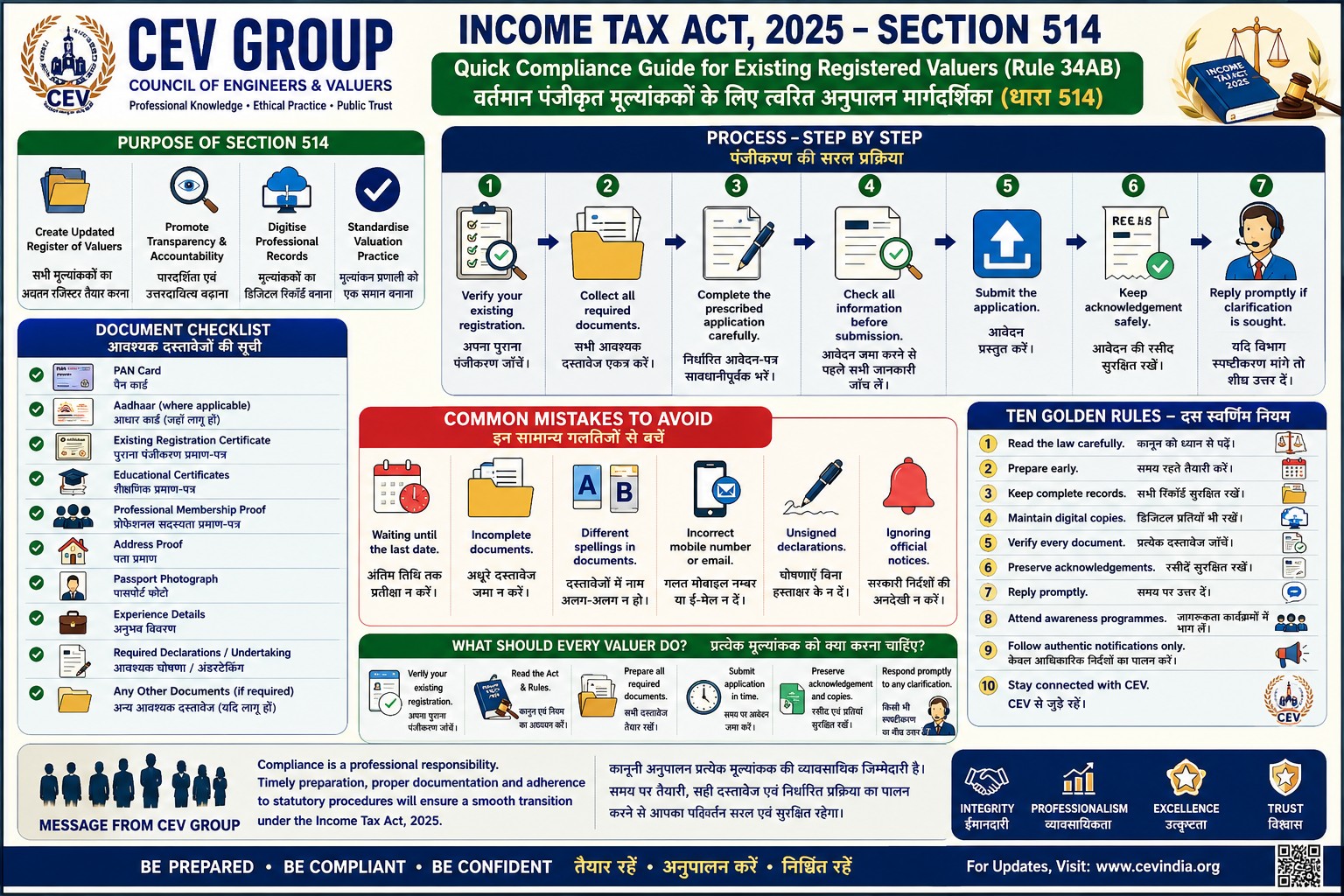
WHAT IS THE PURPOSE OF SECTION 514?
धारा 514 का उद्देश्य क्या है?
| English | हिन्दी |
|---|---|
| Create an updated register of valuers. | सभी मूल्यांककों का अद्यतन रजिस्टर तैयार करना। |
| Promote transparency and accountability. | पारदर्शिता एवं उत्तरदायित्व बढ़ाना। |
| Digitise professional records. | मूल्यांककों का डिजिटल रिकॉर्ड तैयार करना। |
| Standardise valuation practice. | मूल्यांकन प्रणाली को एक समान एवं व्यवस्थित बनाना। |
WHAT SHOULD EVERY EXISTING VALUER DO?
प्रत्येक वर्तमान Registered Valuer को क्या करना चाहिए?
✅ Verify your existing registration.
➡ अपना पुराना पंजीकरण सत्यापित करें।
✅ Read the Income Tax Act, 2025 and Income Tax Rules, 2026.
➡ आयकर अधिनियम, 2025 एवं आयकर नियम, 2026 का अध्ययन करें।
✅ Prepare all required documents.
➡ सभी आवश्यक दस्तावेज तैयार रखें।
✅ Submit the prescribed application in time.
➡ निर्धारित आवेदन समय पर प्रस्तुत करें।
✅ Preserve acknowledgement and copies.
➡ आवेदन की रसीद एवं प्रतियां सुरक्षित रखें।
DOCUMENT CHECKLIST
आवश्यक दस्तावेजों की सूची
| ✔ English | ✔ हिन्दी |
| PAN Card | पैन कार्ड |
| Aadhaar (where applicable) | आधार कार्ड (जहाँ लागू हो) |
| Existing Registration Certificate | पुराना पंजीकरण प्रमाण-पत्र |
| Educational Certificates | शैक्षणिक प्रमाण-पत्र |
| Professional Membership Proof | प्रोफेशनल सदस्यता प्रमाण-पत्र |
| Address Proof | पता प्रमाण |
| Passport Photograph | पासपोर्ट फोटो |
| Experience Details | अनुभव विवरण |
| Required Declarations | आवश्यक घोषणा / Undertaking |
STEP-BY-STEP PROCESS
पंजीकरण की सरल प्रक्रिया
STEP 1
Verify your existing registration.
➡ अपना पुराना पंजीकरण जाँचें।
↓
STEP 2
Collect all required documents.
➡ सभी आवश्यक दस्तावेज एकत्र करें।
↓
STEP 3
Complete the prescribed application carefully.
➡ निर्धारित आवेदन-पत्र सावधानीपूर्वक भरें।
↓
STEP 4
Check all information before submission.
➡ आवेदन जमा करने से पहले सभी जानकारी जाँच लें।
↓
STEP 5
Submit the application.
➡ आवेदन प्रस्तुत करें।
↓
STEP 6
Keep acknowledgement safely.
➡ आवेदन की रसीद सुरक्षित रखें।
↓
STEP 7
Reply promptly if clarification is sought.
➡ यदि विभाग स्पष्टीकरण मांगे तो शीघ्र उत्तर दें।
COMMON MISTAKES TO AVOID
इन सामान्य गलतियों से बचें
❌ Waiting until the last date.
अंतिम तिथि तक प्रतीक्षा न करें।
❌ Incomplete documents.
अधूरे दस्तावेज जमा न करें।
❌ Different spellings in documents.
दस्तावेजों में नाम अलग-अलग न हो।
❌ Incorrect mobile number or email.
गलत मोबाइल नम्बर या ई-मेल न दें।
❌ Unsigned declarations.
घोषणाएँ बिना हस्ताक्षर के न दें।
❌ Ignoring official notices.
सरकारी निर्देशों की अनदेखी न करें।
TEN GOLDEN RULES
दस स्वर्णिम नियम
| English | हिन्दी |
| Read the law carefully. | कानून को ध्यान से पढ़ें। |
| Prepare early. | समय रहते तैयारी करें। |
| Keep complete records. | सभी रिकॉर्ड सुरक्षित रखें। |
| Maintain digital copies. | डिजिटल प्रतियाँ भी रखें। |
| Verify every document. | प्रत्येक दस्तावेज जाँचें। |
| Preserve acknowledgements. | रसीदें सुरक्षित रखें। |
| Reply promptly. | समय पर उत्तर दें। |
| Attend awareness programmes. | जागरूकता कार्यक्रमों में भाग लें। |
| Follow authentic notifications only. | केवल आधिकारिक निर्देशों का पालन करें। |
| Stay connected with CEV. | CEV से जुड़े रहें। |
CEV’S MESSAGE TO MEMBERS
CEV का अपने सदस्यों के लिए संदेश
English
Compliance is a professional responsibility. Timely preparation, proper documentation and adherence to statutory procedures will ensure a smooth transition under the Income Tax Act, 2025.
हिन्दी
कानूनी अनुपालन प्रत्येक मूल्यांकक की व्यावसायिक जिम्मेदारी है। समय पर तैयारी, सही दस्तावेज एवं निर्धारित प्रक्रिया का पालन करने से नए कानून के अंतर्गत आपका परिवर्तन सरल एवं सुरक्षित रहेगा।
REMEMBER
याद रखें
“A Good Valuer is Known Not Only by Technical Knowledge but Also by Ethical Conduct and Regulatory Compliance.”
“एक श्रेष्ठ मूल्यांकक केवल अपने तकनीकी ज्ञान से नहीं, बल्कि ईमानदारी, नैतिकता और कानून के पालन से पहचाना जाता है।”
Published in Public Interest by
Council of Engineers & Valuers (CEV)
Professional Knowledge • Ethical Practice • Regulatory Compliance
व्यावसायिक ज्ञान • नैतिक आचरण • कानूनी अनुपालन
Why Every Registered Valuer Should Read This Article
The introduction of the Income Tax Act, 2025 is not merely a legislative replacement of an earlier statute. It represents a comprehensive restructuring of the manner in which valuation professionals are recognised for purposes of the Income Tax law.
Many practising valuers are asking:
- Will my existing registration continue automatically?
- Is a fresh registration required?
- What documents have to be submitted?
- What is the prescribed application procedure?
- What happens if an application contains deficiencies?
- Can I continue to undertake valuation assignments during the transition period?
- What responsibilities do existing Rule 34AB valuers have under the new Rules?
These are practical questions affecting the day-to-day professional practice of valuers across the country.
The Evolution of Valuation under Income Tax Law
Professional valuation has always played an important role in taxation.
Whether the issue relates to capital gains, acquisition of property, determination of fair market value, assessment of assets or other tax matters, valuation reports prepared by recognised professionals form an important component of tax administration.
Recognising the importance of independent valuation, the Government has historically prescribed a framework for registration of valuers.
Over time, however, professional standards, technology, documentation practices and regulatory expectations have evolved considerably.
Digital record management, electronic filing, transparent regulatory oversight and uniform professional standards have become essential components of modern governance.
The Income Tax Act, 2025 reflects this evolution.
Rather than merely continuing the earlier system, it introduces a modern regulatory framework intended to maintain an updated database of authorised valuers while ensuring greater accountability and administrative efficiency.
Section 514—The Foundation of the New Regulatory Framework
Section 514 occupies a central position in the new statutory framework governing valuers.
Its objective is to provide legal recognition to professionals authorised to undertake valuation assignments under the Income Tax Act while ensuring that their credentials remain current and properly documented.
The legislative philosophy appears to focus upon three broad objectives:
First, maintaining an authentic national database of registered valuers.
Second, ensuring that information relating to every registered valuer remains updated.
Third, strengthening administrative transparency and regulatory oversight.
From a professional perspective, this should be viewed not merely as another compliance requirement but as an opportunity to modernise the profession and improve public confidence in valuation reports.
The Transition Challenge
Whenever a new regulatory framework replaces an earlier one, transitional provisions become extremely important.
Without them, thousands of existing professionals could face uncertainty.
The Income Tax Rules, 2026 recognise this practical reality by providing a transition mechanism for valuers who already possessed valid registration under the earlier framework.
This demonstrates an important legislative principle.
The intention is not to disregard the experience and professional standing of existing valuers.
Instead, the law seeks to bring them into the new statutory framework through a prescribed transition process.
This distinction is important.
Many members mistakenly believe that a transition process is equivalent to obtaining an entirely fresh registration.
The available framework suggests that the emphasis is on bringing existing professionals into the updated statutory system through compliance with prescribed procedural requirements.
Existing Rule 34AB Valuers—What Does the New Framework Mean?
Thousands of valuers across India have been practising under the earlier registration framework applicable to Income Tax Valuers.
For these professionals, the new Rules have both reassuring and cautionary aspects.
The reassuring aspect is that the Rules recognise the existence of validly registered professionals.
The cautionary aspect is equally important.
Recognition under the earlier framework does not eliminate the obligation to comply with the procedural requirements prescribed under the new Rules.
Members should therefore avoid assuming that no action is required on their part.
Professional prudence demands timely compliance with every procedural requirement notified by the competent authority.
Registration versus Updation—Understanding the Difference
One of the most common misconceptions among professionals is that every statutory application necessarily represents a fresh registration.
In reality, regulatory systems often distinguish between:
- Initial registration,
- Renewal,
- Migration,
- Validation,
- Updation of particulars, and
- Continuation under transitional provisions.
The transition contemplated under the Income Tax Rules, 2026 appears to be designed to integrate existing valuers into the new statutory framework through an application process that updates and verifies professional particulars.
Understanding this distinction is important because it influences the documentation required, the manner of filing and the expectations of the regulatory authority.
The Importance of Accurate Applications
No professional wishes to experience unnecessary delay in obtaining recognition under the new framework.
Yet experience across regulatory systems consistently demonstrates that the majority of delays arise from procedural deficiencies rather than lack of eligibility.
Applications may face scrutiny for reasons such as:
- incomplete particulars;
- omission of mandatory declarations;
- missing supporting documents;
- inconsistencies in personal information;
- failure to use the prescribed format; or
- submission of outdated records.
Each of these issues is entirely avoidable through careful preparation.
Accordingly, every valuer should treat the application process with the same degree of professional diligence that is expected while preparing a valuation report.
Professional Responsibility in a Changing Regulatory Environment
Registered valuers occupy a position of trust.
Their reports influence taxation, litigation, banking, financial reporting and numerous commercial transactions.
Consequently, regulators are increasingly placing emphasis on transparency, traceability and documentary compliance.
The transition to the Income Tax Act, 2025 should therefore be viewed in this broader context.
Professional credibility is no longer measured solely by technical competence.
It also depends upon regulatory compliance, maintenance of updated records, timely filing of statutory applications and adherence to prescribed procedures.
Role of the Council of Engineers & Valuers
The Council of Engineers & Valuers has consistently advocated for professional excellence, ethical standards and constructive engagement with regulatory authorities.
Recognising the significance of the new statutory framework, the Council has initiated efforts to:
- study the Income Tax Act, 2025 and the Income Tax Rules, 2026;
- identify practical issues affecting existing valuers;
- seek procedural clarifications from the competent authorities;
- disseminate authentic information among members;
- prepare guidance notes, checklists and educational material; and
- assist professionals in understanding their obligations under the new regime.
The Council believes that proactive communication between professional organisations and regulators will facilitate smoother implementation and reduce uncertainty among practitioners.
Issues Requiring Further Clarification
While the statutory framework provides the basis for transition, several practical questions continue to arise among professionals. These include:
- Whether additional qualifications, if any, are required for existing valuers.
- The precise scope of the application to be filed under the new framework.
- The complete list of supporting documents to accompany the application.
- The treatment of applications containing minor procedural deficiencies.
- The status of existing registrations while transition applications are under process.
- Expected timelines for scrutiny and approval.
- Whether further guidance, standard operating procedures or FAQs will be issued by the tax administration.
The Council considers it appropriate that these issues receive clear and uniform clarification so that implementation remains consistent throughout the country.
What Members Should Do Immediately
Pending comprehensive clarifications, every practising valuer should:
- Carefully study the provisions of the Income Tax Act, 2025 and the Income Tax Rules, 2026.
- Review all existing registration records and preserve certified copies.
- Update personal and professional particulars wherever necessary.
- Organise educational, professional and identity documents in digital as well as physical form.
- Maintain a record of all correspondence submitted to regulatory authorities.
- Follow only authentic notifications and avoid relying on unverified social media interpretations.
- Remain connected with the Council of Engineers & Valuers for verified guidance and professional updates.
CEV TECHNO NEWS – SPECIAL INVESTIGATION
PART II-A
SECTION 514 OF THE INCOME TAX ACT, 2025
Registration of Existing Rule 34AB Valuers under the Income Tax Rules, 2026
A Practical Compliance Guide for Members of the Council of Engineers & Valuers
From Recognition to Compliance: The Next Step
The valuation profession is undergoing a structured regulatory transition. While the statutory framework recognises existing valuers, continuation under the new regime requires careful adherence to the procedure prescribed under the Income Tax Act, 2025 and the Income Tax Rules, 2026.
For practising valuers, this transition should not be viewed merely as another administrative exercise. Rather, it is an opportunity to establish a complete, updated and digitally verifiable professional profile before the Income Tax Department.
The Council of Engineers & Valuers advises every member to begin preparations well before the prescribed deadline so that any deficiency, if noticed by the authority, can be rectified within the available time.
Understanding the Transition Process
Although the detailed administrative workflow may evolve through official notifications and clarifications, the transition process for existing valuers broadly consists of the following stages:
Stage 1 – Verify Eligibility
The valuer should first ensure that:
- the earlier registration was valid under the applicable provisions;
- there is no suspension or cancellation affecting the registration;
- personal particulars are current;
- educational and professional qualifications are supported by documentary evidence.
Only after this self-verification should the application process be initiated.
Stage 2 – Collect Supporting Documents
Applicants should compile all documents likely to be required under the Rules.
Rather than collecting documents at the last moment, members should maintain both:
- scanned digital copies, and
- self-attested physical copies.
This practice significantly reduces delays during submission.
Stage 3 – Review Personal Particulars
Before filing any statutory application, members should verify that all particulars are consistent across records, including:
- name,
- date of birth,
- PAN,
- Aadhaar (where applicable),
- correspondence address,
- email address,
- mobile number,
- educational qualifications,
- professional memberships.
Even minor inconsistencies often result in avoidable correspondence with the authority.
Stage 4 – Prepare the Prescribed Application
Applications should be prepared strictly in accordance with the format prescribed under the Income Tax Rules, 2026.
Members should avoid:
- altering the prescribed format,
- leaving mandatory fields blank,
- attaching illegible copies,
- submitting unsigned declarations.
Professional presentation reflects professional competence.
Stage 5 – Final Verification
Before submission, applicants should conduct a final review.
A useful practice is to verify every attachment against a checklist.
Many experienced professionals ask a colleague to review the application before filing.
Such peer verification frequently identifies omissions that would otherwise delay approval.
Stage 6 – Submission
Applications should be submitted only through the mode prescribed by the competent authority.
Members should preserve:
- acknowledgement,
- application number,
- proof of submission,
- copies of every document submitted.
These records may become important during future correspondence.
Stage 7 – Responding to Queries
If the authority seeks clarification or additional documents, members should respond promptly.
Delayed responses may unnecessarily prolong processing.
Every communication should be:
- courteous,
- complete,
- properly indexed,
- supported by documentary evidence.
Suggested Registration Workflow
Existing Rule 34AB Registered Valuer
               │
               ▼
Study Income Tax Act, 2025
               │
               ▼
Study Income Tax Rules, 2026
               │
               ▼
Verify Existing Registration
               │
               ▼
Compile Required Documents
               │
               ▼
Review Personal Details
               │
               ▼
Prepare Prescribed Application
               │
               ▼
Internal Verification
               │
               ▼
Submit Application
               │
               ▼
Receive Acknowledgement
               │
               ▼
Reply to Queries (if any)
               │
               ▼
Grant of Registration under the New Framework
Suggested Document Preparation Checklist
While members should follow the exact requirements prescribed by the competent authority, the following master checklist may assist in organising records:
Identity
□ PAN Card
□ Aadhaar/Identity Proof (where applicable)
□ Recent Passport Photograph
Professional Records
□ Existing Registration Certificate
□ Previous Renewal Documents (if any)
□ Professional Membership Certificates
□ Experience Details
Educational Records
□ Degree Certificates
□ Technical Qualification Certificates
□ Professional Training Certificates
Address Records
□ Residential Address Proof
□ Office Address Proof
□ Updated Contact Details
Declarations
□ Self-declaration
□ Undertakings
□ Self-attestation wherever required
Supporting Records
□ Any additional documents prescribed by the Rules
□ Copies arranged in proper sequence
□ Index of documents
Recommended Personal Compliance File
The Council recommends that every practising valuer maintain a permanent compliance file containing:
- Registration certificates
- Educational qualifications
- PAN
- Aadhaar
- Professional memberships
- Specimen signatures
- Passport photographs
- Updated biodata
- Professional experience
- Continuing Professional Education records
- Copies of all statutory applications
- Correspondence with authorities
Maintaining such a file simplifies compliance under various regulatory frameworks.
Illustrative Compliance Timeline
Although members must follow the timelines officially prescribed by the Government, a prudent compliance schedule may be:
| Stage | Suggested Action |
|---|---|
| Week 1 | Study statutory provisions and identify requirements |
| Week 2 | Collect documents and update personal records |
| Week 3 | Prepare draft application and supporting papers |
| Week 4 | Conduct internal review and rectify deficiencies |
| Week 5 | Submit application |
| Thereafter | Monitor status and promptly respond to any communication from the authority |
Early submission provides adequate time to address any deficiencies before the statutory deadline.
Ten Practical Tips for Members
- Do not wait until the last week for filing.
- Read every instruction in the prescribed form carefully.
- Ensure consistency of name and other particulars across all documents.
- Keep both digital and hard copies of every submission.
- Preserve acknowledgements securely.
- Respond promptly to communications from the authority.
- Avoid relying on unofficial advice circulated through social media.
- Attend professional awareness programmes organised by recognised institutions.
- Maintain updated contact details with the registering authority.
- Follow official notifications issued from time to time.
Role of Professional Organisations
Professional organisations have an important role in facilitating smooth implementation of regulatory reforms.
The Council of Engineers & Valuers proposes to assist members through:
- Awareness seminars;
- Webinars on the new statutory framework;
- Model document checklists;
- Compliance guidance notes;
- Frequently Asked Questions;
- Representation of common professional issues before the competent authorities;
- Publication of authentic updates through CEV TECHNO NEWS.
The objective is to minimise uncertainty and promote uniform compliance across the profession.
A Profession Moving Towards Greater Accountability
The introduction of Section 514 should be viewed as part of the broader movement towards transparency, digitisation and professional accountability.
Valuers today are expected not only to possess technical competence but also to demonstrate impeccable compliance with statutory requirements. A well-maintained professional record, timely regulatory filings and adherence to prescribed procedures enhance the credibility of both the individual valuer and the profession as a whole.
CEV TECHNO NEWS – SPECIAL INVESTIGATION
PART II-B(1)
SECTION 514 OF THE INCOME TAX ACT, 2025
Frequently Asked Questions (FAQs) and Practical Compliance Guidance for Existing Registered Valuers
Prepared by:
Research & Policy Cell
Council of Engineers & Valuers (CEV)
Frequently Asked Questions (FAQs)
Q1. Why has a new registration framework been introduced under the Income Tax Act, 2025?
The new framework seeks to create a modern, transparent and updated system for recognising valuers authorised to undertake valuation assignments under the Income Tax Act. It is intended to maintain an accurate register of professionals and strengthen regulatory oversight.
Q2. Does the new law affect existing Rule 34AB Registered Valuers?
Yes. Existing valuers should carefully examine the transition provisions contained in the Income Tax Act, 2025 and the Income Tax Rules, 2026 and comply with the prescribed procedure for continuation under the new framework.
Q3. Is every existing valuer required to take action?
Members should not assume that no action is required. Every existing registered valuer should verify the applicable transition requirements and complete the prescribed formalities within the notified time.
Q4. Is this a completely fresh registration?
The transition process is intended to bring existing valuers into the new statutory framework. Members should carefully distinguish between an entirely new registration and a statutory migration or updation process under transitional provisions.
Q5. Why is timely filing important?
Timely filing reduces the possibility of last-minute deficiencies, allows adequate time for rectification and demonstrates professional compliance with statutory requirements.
Q6. What should members do before submitting an application?
Verify eligibility, collect supporting documents, review personal particulars, prepare the prescribed application carefully and conduct a final internal verification before submission.
Q7. Can incomplete applications create problems?
Yes. Missing documents, incomplete declarations or inconsistent information may delay processing or require further clarification.
Q8. Should digital copies of documents be maintained?
Absolutely. Every valuer should maintain organised digital as well as physical records of all statutory documents.
Q9. Why is document consistency important?
Differences in spelling of names, addresses or identification details across records often result in avoidable queries from the authority.
Q10. Should acknowledgements be preserved?
Yes. Members should retain acknowledgements, application references and copies of all correspondence for future reference.
Q11. Can professional organisations assist members?
Yes. Organisations such as the Council of Engineers & Valuers can help by conducting awareness programmes, publishing guidance notes and representing common issues before the authorities.
Q12. Should members rely on social media advice?
No. Regulatory compliance should always be based upon statutory provisions and authentic communications issued by the competent authorities.
Q13. Is maintaining a compliance file necessary?
It is highly advisable. A well-maintained compliance file saves considerable time whenever statutory information is required.
Q14. Should educational records be updated?
Yes. Members should ensure that educational qualifications and professional credentials are readily available and properly documented.
Q15. Why is early preparation recommended?
Early preparation provides sufficient time to identify deficiencies and complete corrective action before the statutory deadline.
Q16. What if the authority seeks clarification?
Members should respond promptly, courteously and with complete supporting documents.
Q17. Should applications be reviewed before submission?
Yes. A final review significantly reduces the possibility of errors and omissions.
Q18. Can old contact details create complications?
Yes. Incorrect addresses, mobile numbers or email IDs may prevent timely receipt of official communications.
Q19. What records should be permanently preserved?
Registration certificates, educational qualifications, PAN, identity proof, correspondence, acknowledgements and copies of statutory applications.
Q20. Is professional record management becoming more important?
Yes. Modern regulatory systems increasingly expect professionals to maintain complete, updated and verifiable records.
Q21. Can delays affect professional practice?
Delays in compliance may create uncertainty regarding regulatory status. Members should therefore complete all procedural requirements as early as possible.
Q22. Is peer review of the application useful?
Yes. Having another experienced professional review the application often helps identify omissions before submission.
Q23. Should members attend awareness programmes?
Certainly. Professional seminars and workshops organised by recognised institutions help members understand new regulatory developments.
Q24. What is the Council’s advice regarding documentation?
Prepare documents systematically, index them properly and maintain both hard and electronic copies.
Q25. Can future clarifications modify procedural requirements?
Yes. Members should regularly monitor official notifications and follow any additional instructions issued by the competent authority.
Q26. Should every communication with the authority be preserved?
Yes. Maintaining a complete communication record is a sound professional practice.
Q27. What is the greatest mistake professionals make during transitions?
Assuming that compliance is automatic without carefully reading the applicable statutory provisions.
Q28. How should valuers approach the new framework?
Not as a burden, but as an opportunity to strengthen professional credibility through regulatory compliance.
Q29. What role does continuing professional education play?
Regular learning helps valuers remain updated with legislative changes, professional standards and regulatory expectations.
Q30. What is the most important message for existing valuers?
Prepare early, maintain accurate records, follow only authentic guidance and complete every statutory requirement within the prescribed timeframe.
Common Mistakes That May Delay Processing
The Council has identified several common deficiencies that professionals should avoid:
Documentation Errors
- Missing supporting documents.
- Illegible photocopies.
- Documents not arranged in sequence.
- Uncertified copies where certification is required.
Personal Information Errors
- Different spellings of the applicant’s name.
- Outdated address.
- Incorrect mobile number.
- Inactive email address.
- Inconsistent identification details.
Application Errors
- Blank mandatory fields.
- Unsigned declarations.
- Incorrect form version.
- Missing annexures.
- Failure to attach an index of documents.
Professional Errors
- Waiting until the last date.
- Ignoring official notifications.
- Depending upon unofficial advice.
- Failing to preserve acknowledgement receipts.
Ten Golden Rules for Every Registered Valuer
- Read the law before filing.
- Begin preparations early.
- Maintain complete documentation.
- Keep both physical and digital records.
- Verify every entry before submission.
- Preserve acknowledgements carefully.
- Respond promptly to official communications.
- Attend professional awareness programmes.
- Stay connected with recognised professional organisations.
- Follow only authentic Government notifications.
Professional Excellence Requires Regulatory Excellence
Technical knowledge alone is no longer sufficient.
The modern valuation profession expects every practitioner to combine:
- Technical competence,
- Ethical conduct,
- Professional independence,
- Transparent documentation,
- Timely statutory compliance, and
- Continuous professional development.
These qualities together build public confidence in the valuation profession and strengthen its role in the administration of tax laws.
CEV TECHNO NEWS – SPECIAL INVESTIGATION
PART II-B(2)
SECTION 514 OF THE INCOME TAX ACT, 2025
Policy Recommendations, Editorial Opinion and the Future Roadmap for Registered Valuers
An Editorial by the Council of Engineers & Valuers (CEV)
Editorial Perspective
A Reform That Must Inspire Confidence, Not Confusion
Every major legislative reform brings with it opportunities as well as challenges. The introduction of the Income Tax Act, 2025 and the Income Tax Rules, 2026 is undoubtedly one such reform for the valuation profession.
The Council of Engineers & Valuers welcomes every initiative that strengthens professionalism, transparency and accountability. At the same time, successful implementation of any new legal framework depends not only upon the legislation itself but also upon clear procedures, effective communication and consistent implementation throughout the country.
A transition involving thousands of existing valuers should be guided by the principles of simplicity, certainty and fairness.
The objective of the law should be to facilitate compliance—not to create avoidable procedural uncertainty.
The Need for Uniform Implementation
One of the most common concerns expressed by professionals is the possibility of different interpretations by different field offices.
Uniformity is essential.
Every applicant, irrespective of the State or jurisdiction in which he or she practices, should receive the same procedural guidance, the same documentation requirements and the same standards of scrutiny.
Consistency promotes confidence.
Inconsistency creates uncertainty.
The Council believes that nationally uniform implementation will greatly enhance the credibility of the new framework.
The Importance of Clear Administrative Guidance
Experience from earlier regulatory reforms demonstrates that uncertainty usually arises not because of deficiencies in legislation but because of the absence of detailed procedural guidance.
Accordingly, the Council believes that comprehensive administrative guidance would be beneficial for both the Income Tax Department and valuation professionals.
Such guidance may include:
- detailed Frequently Asked Questions (FAQs);
- illustrative examples;
- specimen application formats;
- document checklists;
- guidance on rectification of deficiencies;
- timelines for processing;
- guidance on communication with applicants.
These measures would promote voluntary compliance and reduce avoidable correspondence.
Policy Recommendations of the Council of Engineers & Valuers
In the interest of smooth implementation, the Council respectfully offers the following recommendations for consideration by the competent authorities.
1. Publication of a Comprehensive Guidance Manual
A detailed handbook explaining every stage of the registration process would greatly assist professionals across the country.
The manual may include:
- statutory provisions;
- procedural workflow;
- specimen applications;
- common deficiencies;
- model declarations;
- document checklists.
2. Development of a Dedicated Online Registration Portal
A digital portal would provide:
- electronic filing;
- document uploading;
- acknowledgement generation;
- application tracking;
- online deficiency notices;
- electronic approval.
Such a system would reduce paperwork and improve administrative efficiency.
3. Standard Operating Procedure (SOP) for Field Authorities
A uniform SOP would ensure that all applications are processed on consistent parameters throughout India.
This would minimise regional variations and promote transparency.
4. Time-Bound Disposal of Applications
The Council recommends that applications be processed within a clearly defined administrative timeline, subject to the applicant furnishing complete information.
Predictable timelines enhance professional confidence and administrative accountability.
5. Facility for Rectification of Minor Deficiencies
Applications occasionally contain clerical or documentary deficiencies.
Instead of outright rejection, applicants may be provided an opportunity to rectify such deficiencies within a specified period.
This approach would encourage compliance while maintaining procedural fairness.
6. National Awareness Programme
The Council recommends that awareness programmes be organised jointly with professional bodies to familiarise valuers with the new statutory framework.
Webinars, regional workshops and explanatory booklets would significantly improve understanding.
7. Regular Publication of Clarifications
As practical questions emerge during implementation, periodic clarifications issued by the competent authority would ensure consistency and reduce uncertainty.
Issues Requiring Further Clarification
While appreciating the legislative intent, the Council believes that clarification on certain practical issues would be beneficial.
These include:
- detailed eligibility criteria for transition cases;
- complete list of supporting documents;
- treatment of applications with minor deficiencies;
- procedure for correction of submitted information;
- expected processing timelines;
- status of applications pending scrutiny;
- mechanism for communication of deficiencies;
- availability of appeal or review in procedural matters;
- process for updating future changes in particulars;
- preservation and accessibility of registration records.
Clarification on these matters would help professionals comply more effectively.
The Expanding Role of the Modern Valuer
The profession of valuation has evolved considerably over the past two decades.
Today’s valuer is expected to possess not only technical knowledge but also:
- legal awareness;
- regulatory understanding;
- financial literacy;
- digital documentation skills;
- ethical judgment;
- professional independence.
Future valuation practice will increasingly require integration of engineering knowledge, market analysis, technology and statutory compliance.
The modern valuer is therefore both a technical expert and a regulatory professional.
Preparing for the Future
The Council encourages members to view regulatory compliance as a component of professional excellence.
Every practising valuer should strive to maintain:
- updated professional records;
- continuous learning;
- digital documentation;
- high ethical standards;
- transparent work practices;
- timely statutory compliance.
These practices enhance individual credibility and strengthen public confidence in the profession.
The Council’s Commitment
The Council of Engineers & Valuers reaffirms its commitment to:
- protecting the legitimate interests of valuation professionals;
- promoting ethical practice;
- encouraging continuing professional education;
- assisting members in understanding new laws;
- engaging constructively with Government authorities;
- publishing authentic professional guidance;
- supporting regulatory reforms that strengthen the profession.
The Council will continue to represent practical issues affecting members and to advocate for clear, transparent and efficient implementation of the new framework.
Action Plan for Every Existing Registered Valuer
The Council recommends the following immediate action plan:
Step 1
Study the relevant provisions of the Income Tax Act, 2025 and the Income Tax Rules, 2026.
Step 2
Verify your existing registration status and maintain updated records.
Step 3
Organise all educational, professional and identity documents in both physical and digital form.
Step 4
Monitor official notifications issued by the competent authority.
Step 5
Complete all prescribed procedural requirements within the applicable timelines.
Step 6
Retain copies of all applications, acknowledgements and correspondence.
Step 7
Participate in professional development programmes organised by recognised institutions.
Step 8
Consult authentic sources whenever procedural doubts arise.
A Message to Young Engineers and Aspiring Valuers
The valuation profession is entering an era where integrity, technical competence and regulatory compliance will define professional success.
Young engineers aspiring to become valuers should invest in:
- technical excellence;
- legal knowledge;
- valuation standards;
- report writing;
- communication skills;
- digital technologies;
- lifelong learning.
The future belongs to professionals who combine knowledge with discipline and ethics.
Editorial Conclusion
The transition under the Income Tax Act, 2025 is more than an administrative exercise—it is an opportunity to strengthen the institutional foundations of the valuation profession.
With clear statutory guidance, consistent implementation and active cooperation between the Government and professional organisations, India can develop a valuation ecosystem that is transparent, reliable and internationally respected.
The Council of Engineers & Valuers calls upon all members to approach this transition with diligence, professionalism and confidence. By embracing compliance, maintaining the highest ethical standards and continuously upgrading their knowledge, valuers can contribute meaningfully to the credibility of the tax system and to the nation’s economic development.
As further official clarifications and procedural guidance become available, the Council will continue to disseminate authentic information through CEV TECHNO NEWS, seminars, webinars and technical publications, ensuring that every member remains informed and prepared.
Editor’s Closing Note
This special series has been prepared to promote awareness among engineers and valuers regarding the evolving statutory framework governing valuation under the Income Tax Act, 2025. Readers are encouraged to refer to the Act, the Income Tax Rules, 2026 and official notifications issued by the competent authorities for applicable legal requirements. The Council will continue to monitor developments and publish updated guidance for the benefit of the profession.
— Editorial Board
CEV TECHNO NEWS
Council of Engineers & Valuers
Advisory to Council (CEV) Members
The Council of Engineers & Valuers urges all its members engaged in valuation practice to immediately review their compliance status under the new Income Tax provisions. It is advisable to consult updated guidelines, seek expert assistance if required, and ensure that applications are filed correctly and within time.
This development underscores the increasing regulatory scrutiny and the need for professional diligence in maintaining valid credentials in the valuation domain.
For further updates and expert guidance, members are encouraged to stay connected with professional forums and regulatory advisories issued from time to time.


https://youtu.be/XRCXR4aw6Bo?si=IKuK_L6VnaJnl-43