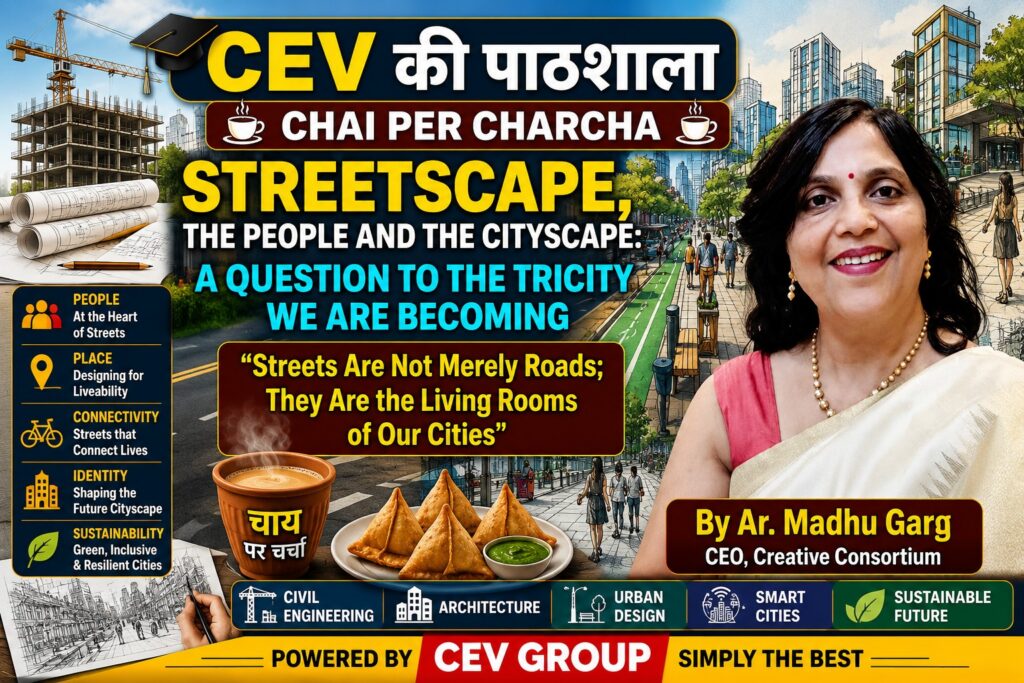

STREETSCAPE, THE PEOPLE AND THE CITYSCAPE: A QUESTION TO THE TRICITY WE ARE BECOMING
“Streets Are Not Merely Roads; They Are the Living Rooms of Our Cities”
By Ar. Madhu Garg
CEO, Creative Consortium
Ar. Madhu Garg, Founder & CEO of Creative Consortium, established the firm in 1990 and transformed it from a two-member practice into one of India’s leading multidisciplinary architecture and engineering consultancies. A graduate of Chandigarh College of Architecture (1981), she is renowned for her people-centric, sustainable, and affordable housing designs. Leading a team of over 50 professionals, she has delivered landmark residential, institutional, healthcare, commercial, retail, and civic projects across India, guided by the principles of functionality, innovation, environmental sensitivity, and timeless design excellence.
There was once a vision that gave birth to Chandigarh—a vision far greater than an exercise in architecture or urban engineering. It was conceived as a living experiment in creating a humane, orderly, and environmentally responsive city where nature, movement, community, and built form existed in harmony.
The celebrated concept of the “City Beautiful” was never intended to be merely a collection of well-planned sectors, impressive buildings, and broad avenues. At its core, it represented a philosophy of human-centred urbanism—a city designed not only for efficiency but also for dignity, social interaction, and quality of life.
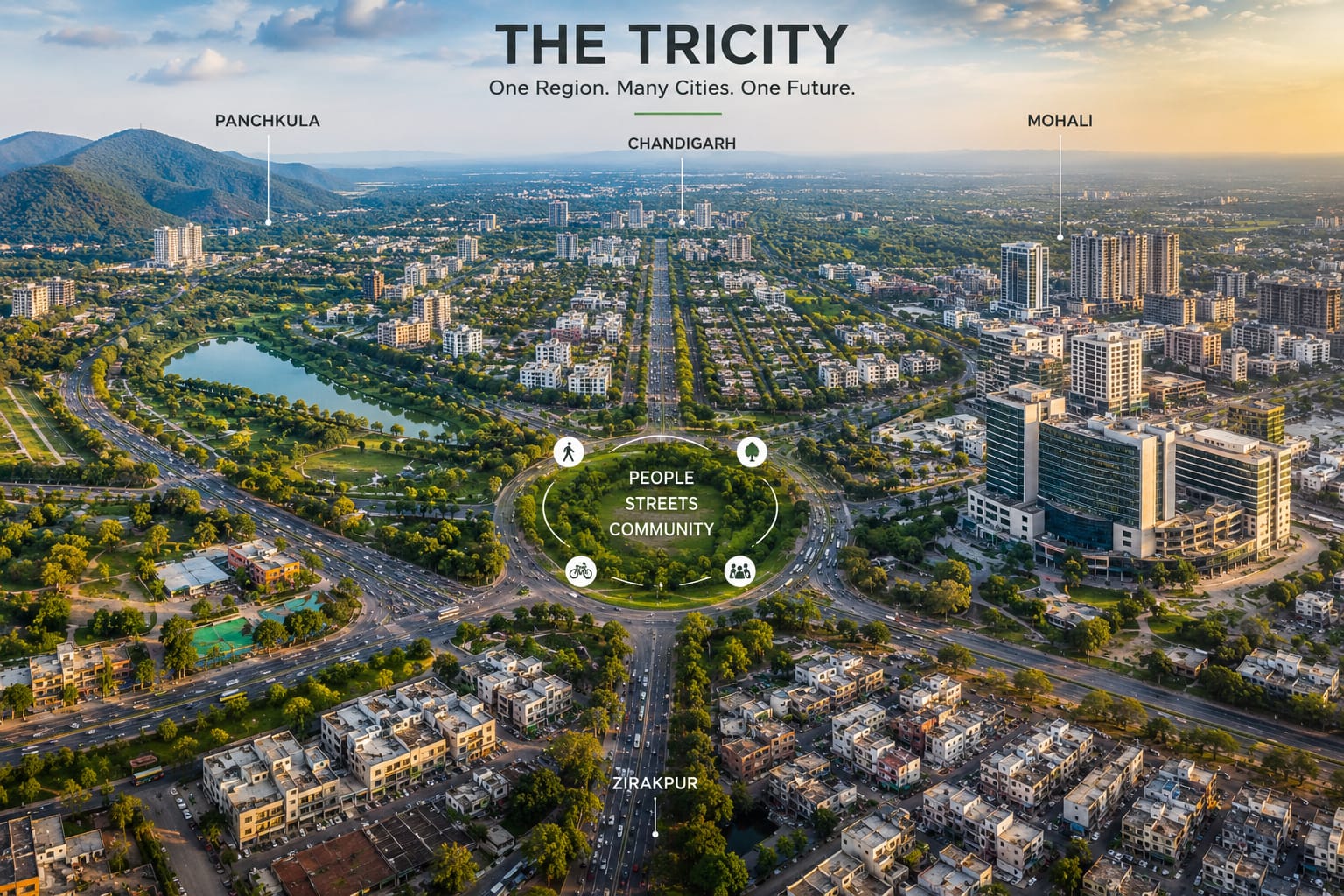
Today, however, Chandigarh has evolved into a much larger urban ecosystem. Together with Mohali, Panchkula, Zirakpur, and the rapidly expanding peripheral settlements, the Tricity region now accommodates an estimated population exceeding 3.2 million people. This unprecedented growth has transformed the region into one of North India’s most dynamic urban clusters, but it has simultaneously generated immense pressure on infrastructure, mobility systems, environmental resources, and social spaces.
Peak-hour traffic congestion on Airport Road, Madhya Marg, Dakshin Marg, Chandigarh-Kharar Corridor, Panchkula-Chandigarh Road, and Zirakpur junctions has become a daily reality. What was once admired as one of India’s most efficient urban mobility networks now faces increasing stress from growing vehicle ownership, fragmented land-use patterns, and continuous outward urban expansion.
This raises a fundamental question:
Are we building cities for people, or are people increasingly being forced to adjust themselves to the pressures created by urban growth?
The Transformation of the Tricity
The urban landscape of the Tricity is changing at a remarkable pace. New residential townships, mixed-use developments, commercial corridors, and high-rise towers continue to emerge across Mohali, New Chandigarh, Zirakpur, and Panchkula.
Agricultural lands that once formed the green buffer around the city are gradually disappearing under expanding urban footprints. Skylines are rising vertically while development spreads horizontally. Roads continue to widen, flyovers multiply, and infrastructure investments grow larger with every passing year.
Yet despite these physical transformations, many indicators suggest that the quality of everyday urban life is under increasing strain.
Traffic congestion worsens despite wider roads.
Pedestrian movement becomes more difficult despite urban expansion.
Public spaces shrink even as private developments become more elaborate.
Green cover diminishes while temperatures continue to rise.
Neighbourhood interaction weakens despite increasing residential density.
The paradox of contemporary urbanisation is becoming increasingly evident: cities are becoming larger, but not necessarily more liveable.
The Vanishing Human Relationship with the Street
Historically, streets have never been merely transportation corridors.
They have been places of interaction, culture, commerce, recreation, and community life. Streets have traditionally served as extensions of neighbourhood living rooms where children played, neighbours interacted, vendors conducted business, and communities celebrated together.
Today, however, many urban streets have gradually lost this social function.
The street is increasingly viewed only through the lens of vehicular movement.
Children seldom enjoy the freedom to play safely outside their homes.
Senior citizens often hesitate before navigating roads dominated by fast-moving traffic.
Pedestrians struggle with discontinuous footpaths, encroachments, inadequate shade, and unsafe crossings.
Cycling, once a natural part of daily life, has become increasingly challenging.
Neighbourhood interactions are slowly being replaced by isolated lifestyles within gated communities and apartment complexes.
Even the simple act of walking—a fundamental urban experience—often becomes inconvenient, unsafe, and stressful.
The challenge before us therefore extends far beyond infrastructure provision. It concerns the very character and quality of urban life.
A City is More Than Its Buildings
As architects, planners, engineers, valuers, and policymakers, we must continuously ask ourselves:
- Why are our roads becoming wider but less liveable?
- Why are our neighbourhoods becoming denser yet socially disconnected?
- Why are our cities growing taller while public life at the ground level diminishes?
- Why are streets designed primarily for movement rather than belonging?
- Why do we measure urban success through construction activity rather than human experience?
The answer lies in recognising that a city cannot become beautiful merely through iconic buildings, elevated corridors, commercial complexes, or impressive skylines.
A truly successful city is one where people develop an emotional connection with their surroundings.
The essence of urban beauty lies not only in what we build, but in how people experience what is built.
Reimagining the Meaning of a “City Beautiful”
A genuinely beautiful city is one where:
- Streets are shaded, comfortable, walkable, and universally accessible.
- Children can cycle and play without fear.
- Elderly citizens move with dignity and independence.
- Public spaces foster inclusivity and social interaction.
- Green infrastructure forms an integral part of urban design.
- Neighbours know and support one another.
- Community life thrives beyond the confines of private property.
- Development balances economic growth with environmental responsibility.
Such cities are not defined by architectural monuments alone. They are defined by the everyday experiences of ordinary citizens.
Climate Change and the Urban Heat Challenge
The Tricity region is increasingly experiencing the consequences of rapid urbanisation through the phenomenon known as the Urban Heat Island Effect.
Large expanses of concrete, asphalt, paving blocks, and glass absorb solar radiation throughout the day and release heat during the evening. Simultaneously, shrinking tree canopies, reduced permeable surfaces, and declining green cover diminish the city’s natural cooling mechanisms.
The result is visible in rising ambient temperatures, increased energy consumption, deteriorating outdoor comfort, and greater vulnerability to climate extremes.
The challenge is no longer theoretical.
It is becoming an everyday lived reality.
The future resilience of the Tricity will depend significantly upon its ability to preserve and expand urban forests, restore ecological networks, encourage climate-responsive design, and prioritise shaded pedestrian environments.
Can Streets Become Social Spaces Again?
Perhaps the time has come to fundamentally rethink the role of our streets.
Can streets become more than channels for vehicular traffic?
Can they once again become places where people pause, converse, celebrate, and belong?
Can urban design create environments where walking becomes pleasurable rather than burdensome?
Can neighbourhood streets evolve into community assets rather than merely transportation infrastructure?
Globally, progressive cities are increasingly adopting people-centric urban design principles that prioritise walkability, cycling infrastructure, public transport integration, street greenery, tactical urbanism, and active public spaces.
The Tricity too must begin moving in this direction.
The future of urban planning cannot remain confined to engineering efficiency alone. It must return to the human scale.
The Shared Responsibility of Citizens
Urban transformation cannot depend solely upon governments, planners, architects, engineers, or municipal authorities.
Citizens themselves are equally important stakeholders in shaping the future character of the city.
One recurring source of neighbourhood tension within dense sectoral housing areas is unorganised parking. High front boundary walls often reduce the flexibility of frontage spaces, forcing vehicles onto public streets and creating conflicts among residents.
A more progressive approach may involve reducing rigid visual barriers and treating road berms, setbacks, and frontage areas as transitional shared zones. Such spaces can facilitate organised parking while maintaining visual openness, passive surveillance, and stronger community interaction.
This reflects a broader urban philosophy:
The street is not merely a movement corridor; it is a shared civic asset where public and private interests can coexist harmoniously through thoughtful design and collective responsibility.
Citizens can contribute significantly by:
- Respecting public spaces.
- Supporting walkability and cycling.
- Planting and preserving trees.
- Reducing excessive dependence on private vehicles.
- Participating in neighbourhood initiatives.
- Encouraging community engagement.
- Promoting responsible use of urban infrastructure.
- Developing a stronger sense of collective ownership toward the city.
Building Communities, Not Merely Structures
Cities ultimately mirror the behaviour and values of their inhabitants.
When people disconnect from their neighbourhoods, urban environments gradually lose their identity, vitality, and social fabric.
The future of the Tricity therefore lies not merely in constructing more buildings, widening more roads, or creating taller skylines. It lies in creating richer urban experiences, stronger communities, healthier environments, and more meaningful public spaces.
Development must not only rise vertically.
It must deepen socially, environmentally, and culturally.
The true success of Chandigarh and the larger Tricity region will not be measured solely by economic indicators, real-estate values, infrastructure investments, or architectural landmarks.
It will be measured by whether future generations can continue to experience streets filled with shade, safety, interaction, inclusivity, and belonging.
Because ultimately, the identity of a city is not defined by concrete, steel, or glass.
It is defined by its people.
And the true measure of urban success is not movement alone, but the quality of life that unfolds within its streetscape and cityscape.
A Final Reflection
The future of the Tricity cannot depend solely upon wider roads, larger developments, and taller buildings. It must depend upon whether a child can safely walk to a neighbourhood park, whether an elderly citizen can comfortably rest beneath the shade of a tree, whether pedestrians feel welcome on the streets, and whether neighbours still find reasons to meet beyond the walls of their apartments.
When cities create these opportunities for human connection, they become more than urban settlements.
They become communities.
And that is when a city truly becomes beautiful.
— Ar. Madhu Garg
CEO, Creative Consortium
Interview with Ar. Madhu Garg
“Streets Are Not Merely Roads; They Are the Living Rooms of Our Cities”
Q1. Your article repeatedly refers to the original vision of Chandigarh as a “City Beautiful.” Do you believe that vision is under threat today?
Answer:
The vision is certainly being challenged, though not necessarily lost. Chandigarh was conceived as a city where human comfort, greenery, movement, and community life existed in balance. Rapid urbanization across the Tricity has created pressures that the original planners could not have anticipated. The challenge before us is to reinterpret the principles of the City Beautiful for a population and urban scale that is many times larger than originally envisioned.
Q2. You argue that roads are becoming wider but cities are becoming less liveable. How do you explain this paradox?
Answer:
Urban planning for many decades has focused heavily on accommodating vehicles. Whenever congestion increases, the immediate response is often to widen roads. However, wider roads usually encourage more vehicles, resulting in what planners call “induced demand.” Meanwhile, pedestrians, cyclists, children, and elderly citizens lose space. Therefore, mobility may improve temporarily, but overall liveability often declines. A successful city must balance movement with human experience.
Q3. What, in your opinion, is the biggest urban challenge currently facing the Tricity region?
Answer:
The greatest challenge is managing growth without compromising quality of life. The Tricity is expanding rapidly through high-rise developments, commercial hubs, and new townships. If this growth is not supported by adequate public transport, walkable neighbourhoods, environmental protection, and social infrastructure, we may gain physical development while losing urban comfort and community well-being.
Q4. You have highlighted the disappearance of the human relationship with the street. Why are streets so important in city planning?
Answer:
Because streets are where public life unfolds. Historically, streets have been places for social interaction, commerce, recreation, and cultural expression. When streets become dominated exclusively by vehicles, communities lose important opportunities for engagement. Vibrant streets create vibrant cities. They are not merely transportation corridors; they are social spaces that help build trust, identity, and belonging.
Q5. Climate change and urban heat are major concerns in your article. What practical measures should cities adopt immediately?
Answer:
The first priority should be protecting and expanding urban tree cover. Secondly, cities should reduce excessive paving and encourage permeable surfaces. Thirdly, all future road projects should integrate shaded pedestrian pathways and cycling infrastructure. Finally, climate-responsive architecture and green infrastructure should become mandatory components of urban development policies. These measures are both environmentally responsible and economically sensible.
Q6. You have suggested rethinking boundary walls and frontage spaces. Some residents may view this as impractical. How would you respond?
Answer:
I am not advocating the elimination of privacy or security. Rather, I am proposing a more intelligent balance between private and public space. Excessively rigid front boundaries often reduce visual openness and create parking conflicts. Shared frontage concepts, when properly designed, can improve neighbourhood aesthetics, increase safety through natural surveillance, and encourage social interaction. Many successful urban environments around the world follow such principles.
Q7. How important is public participation in shaping the future of the Tricity?
Answer:
It is absolutely essential. Governments and planners can create policies and infrastructure, but cities are ultimately shaped by the behaviour of their citizens. Whether we preserve trees, respect public spaces, choose walking over short vehicle trips, or participate in neighbourhood activities—all these actions collectively influence the quality of urban life. Sustainable cities require active citizenship.
Q8. What role should architects and urban designers play in addressing the challenges you have identified?
Answer:
Architects and urban designers must move beyond designing individual buildings and engage more deeply with public spaces and community life. Every project should contribute positively to the larger urban environment. Our responsibility is not only to create structures but also to create places where people feel connected, comfortable, and inspired. Design must serve society, not merely the built form.
Q9. Looking ahead twenty years, what would success for the Tricity look like from your perspective?
Answer:
Success would not be measured by the number of skyscrapers or flyovers. It would be reflected in cleaner air, shaded streets, efficient public transport, safe pedestrian environments, active public spaces, and strong neighbourhood communities. A successful Tricity would be one where growth and sustainability coexist and where future generations enjoy an even better quality of life than the present generation.
Q10. If you could convey one message to policymakers, professionals, and citizens through this article, what would it be?
Answer:
My message is simple: cities must remain human-centred. Development is important, but development without liveability is incomplete. Every planning decision should ultimately answer one question—does it improve the daily life of ordinary citizens? If the answer is yes, we are moving in the right direction. If not, we must rethink our priorities. The future of the Tricity depends not merely on what we build, but on how people experience what we build.
Published by: Council of Engineers and Valuers (CEV)

https://youtu.be/XRCXR4aw6Bo?si=IKuK_L6VnaJnl-43