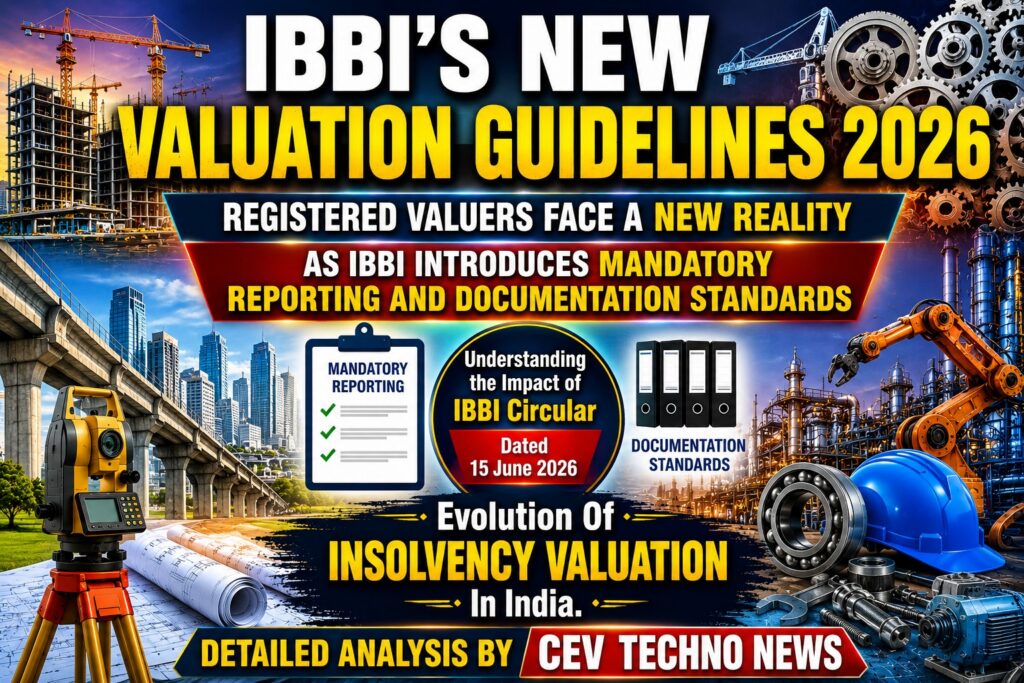

IBBI’S NEW VALUATION GUIDELINES 2026
A Paradigm Shift in Insolvency Valuation Practice
From Asset Valuation to Value Maximisation: Understanding the Impact of IBBI Circular Dated 15 June 2026
Introduction
The Insolvency and Bankruptcy Board of India (IBBI), through Circular No. IBBI/RV/103/2026 dated 15 June 2026, has introduced comprehensive “Guidelines for Conducting Valuation under the Insolvency and Bankruptcy Code, 2016.” These guidelines mark a historic turning point in the evolution of the valuation profession in India.
For years, valuation under the Insolvency and Bankruptcy Code has played a decisive role in Corporate Insolvency Resolution Processes (CIRP), Liquidation Proceedings, Pre-Pack Insolvency, Voluntary Liquidation, and Personal Guarantor Bankruptcy matters. Yet, despite its critical importance, significant variations existed in valuation reports, methodologies, documentation standards, assumptions, and reporting practices.
The new guidelines seek to eliminate these inconsistencies by introducing a uniform, transparent, and auditable framework for valuation assignments under IBC.
More importantly, the circular transforms the role of the Registered Valuer from a mere asset assessor into a key participant in the value maximisation process envisaged under the Code.
Why This Circular Was Necessary
Valuation under IBC directly affects:
- Resolution Plans
- Committee of Creditors (CoC) decisions
- Liquidation outcomes
- Stakeholder recoveries
- Judicial scrutiny before NCLT, NCLAT and Courts
Even a minor variation in valuation may alter creditor recoveries running into crores of rupees.
Over the years, insolvency professionals, lenders, and adjudicating authorities have expressed concerns regarding:
- Inadequate documentation
- Limited disclosure of assumptions
- Non-uniform valuation reports
- Lack of transparency in data sources
- Insufficient justification for valuation conclusions
- Wide divergence between valuers
The new circular is IBBI’s response to these challenges.
The Biggest Change: Documentation Becomes Mandatory
Perhaps the most revolutionary aspect of the guidelines is the emphasis on valuation documentation.
The circular now requires every Registered Valuer to maintain comprehensive records including:
- Client communications
- Working papers
- Supporting evidence
- Alternative methodologies considered
- Risk assessments
- Professional judgments exercised
- Quality control procedures
This effectively means that future valuation assignments will not be judged solely by the final value but also by the valuation process itself.
For the first time, documentation has been elevated to the same importance as the valuation conclusion.
This will significantly improve auditability, accountability, and defensibility of valuation reports.
Standardisation of Valuation Reports
The guidelines prescribe a detailed minimum reporting framework applicable to all valuation assignments under IBC.
Every valuation report must now include:
- Purpose and scope
- Valuer credentials
- Conflict of interest disclosures
- Intended users
- Valuation basis and premise
- Methodology adopted
- Data sources
- Significant assumptions
- Discounts and premiums
- Sustainability factors
- Value conclusions
- Caveats and limitations
This standardisation is expected to bring substantial consistency across valuation assignments nationwide.
For lenders and insolvency professionals, this means easier comparison of reports.
For adjudicating authorities, it means greater confidence in valuation outcomes.
For valuers, it establishes a clear benchmark of professional reporting.
Receivables Can No Longer Be Valued Superficially
Historically, receivables often received inadequate attention during insolvency valuations.
The circular changes this approach dramatically.
Valuers must now evaluate:
- Nature of receivable
- Creditworthiness of debtors
- Related-party relationships
- Ageing analysis
- Legal enforceability
- Recovery history
- Macroeconomic influences
- Industry-specific risks
This is likely to increase the reliability of valuations involving:
- Trade receivables
- Loans and advances
- Tax receivables
- Recoverable claims
The emphasis on debtor KYC, documentation, and recovery patterns will improve the realism of estimated recoveries.
A Landmark Development: Introduction of VRIN
One of the most important innovations is the introduction of the Valuation Report Identification Number (VRIN).
Every valuation report must now carry a unique VRIN generated through the Authority’s system.
The VRIN must appear on every page of the report.
This measure is expected to:
- Improve traceability
- Prevent manipulation
- Enhance authenticity
- Create digital audit trails
- Strengthen regulatory oversight
This may eventually evolve into a nationwide valuation repository system.
Asset-Specific Reporting Frameworks
The circular introduces separate reporting formats for:
Land and Building
Valuers must now report:
- Geographical coordinates
- Circle rates
- Land characteristics
- Development potential
- RERA compliance
- Zoning restrictions
- FAR possibilities
- Ownership history
- Encumbrances
The inclusion of development potential and enhanced FAR analysis indicates IBBI’s focus on asset maximisation rather than mere current use valuation.
Plant and Machinery
The reporting framework now requires:
- Installed and operational capacity
- Manufacturing details
- Maintenance history
- Process layouts
- Obsolescence assessment
- Vendor ecosystem
- Safety compliance
- Pollution control compliance
This significantly increases the technical rigor expected from P&M valuers.
Securities and Financial Assets
The framework expands the scope to include:
- Loans and advances
- Receivables
- Intangible assets
- Goodwill
- Customer relationships
- Intellectual property
- Licenses
- Domain names
This broadens the role of SFA valuers considerably.
Mandatory Engagement with Committee of Creditors
An important and perhaps under-discussed reform is the requirement that valuers explain their methodology to the Committee of Creditors.
This provision promotes:
- Transparency
- Stakeholder confidence
- Better understanding of valuation assumptions
- Reduction in disputes
Valuers will now require not only technical expertise but also communication skills.
The profession is moving towards active stakeholder engagement.
Sustainability and ESG Enter Insolvency Valuation
For the first time, sustainability-related factors have been formally incorporated into valuation reporting.
Valuers must assess:
Environmental Factors
- Pollution compliance
- Environmental impacts
Social Factors
- Connectivity
- Infrastructure access
- Community influence
Governance Factors
- Regulatory approvals
- Compliance framework
- Corporate governance aspects
This aligns Indian insolvency valuation practices with emerging international valuation trends.
The Most Revolutionary Concept: Coordinating Valuer
Without doubt, the introduction of the Coordinating Valuer is the most transformative feature of the circular.
Traditionally, valuation under IBC involved separate asset-wise valuations:
- Land & Building
- Plant & Machinery
- Securities/Financial Assets
The final valuation often became a simple aggregation exercise.
The circular fundamentally changes this approach.
The Coordinating Valuer must now:
- Review all asset-class valuations
- Analyse methodologies
- Assess business synergies
- Evaluate intangible assets
- Determine the integrated fair value of the Corporate Debtor
This marks a shift from “sum of assets” valuation to “value of an operating enterprise.”
Recognition of Synergy Value
The circular explicitly introduces the concept of synergistic value adjustment.
The prescribed framework states:
Fair Value of Corporate Debtor = Aggregate Asset Values + Synergy Value
This is a landmark development.
For years, many insolvency valuations ignored:
- Brand strength
- Customer relationships
- Distribution networks
- Operational efficiencies
- Going-concern advantages
The new framework formally recognises these value drivers.
This approach is likely to increase fair value estimates for many operating businesses.
Intangible Assets Finally Receive Their Due Importance
Historically, intangible assets were often neglected during insolvency valuations.
The Coordinating Valuer is now specifically required to evaluate:
- Brand value
- Trademarks
- Copyrights
- Patents
- Proprietary technology
- Licences
- Customer contracts
- Distribution networks
- Goodwill
This reflects a modern understanding that enterprise value increasingly resides in intangible assets.
For sectors such as technology, pharmaceuticals, e-commerce and services, this reform may significantly influence valuation outcomes.
Implications for Registered Valuers
The circular raises the professional benchmark substantially.
Future valuers must possess:
Technical Competence
Deeper understanding of valuation standards and methodologies.
Documentation Discipline
Comprehensive record maintenance.
Analytical Capability
Ability to justify assumptions and conclusions.
Business Understanding
Assessment of enterprise value, synergies and intangibles.
Communication Skills
Engagement with CoC and stakeholders.
Valuation is no longer a report-writing exercise; it is becoming a sophisticated professional advisory function.
Implications for Insolvency Professionals and Lenders
For Resolution Professionals and Liquidators:
- Improved reliability of valuations
- Better decision support
- Reduced litigation risk
For lenders and CoC members:
- More transparent valuation process
- Better understanding of recovery prospects
- Enhanced confidence in resolution outcomes
For tribunals:
- Better documented reports
- Greater evidentiary value
- Reduced disputes regarding valuation methodology
Evolution Of Insolvency Valuation In India.
The IBBI Circular dated 15 June 2026 represents a watershed moment in the evolution of insolvency valuation in India. The guidelines introduce a structured reporting framework, mandatory documentation standards, VRIN-based traceability, asset-specific valuation formats, sustainability considerations, and most importantly, the revolutionary concept of the Coordinating Valuer with recognition of business synergies and intangible assets.
These reforms signal a decisive movement from simplistic asset valuation towards holistic enterprise valuation.
For Registered Valuers, the message is clear: the future belongs to professionals who can combine technical expertise, rigorous documentation, business understanding, and professional judgment.
The circular is not merely a compliance document. It is a blueprint for the next generation of insolvency valuation practice in India.
As insolvency jurisprudence matures and resolution processes become increasingly sophisticated, this circular may well be remembered as one of the most consequential reforms in the history of the valuation profession under the Insolvency and Bankruptcy Code.