
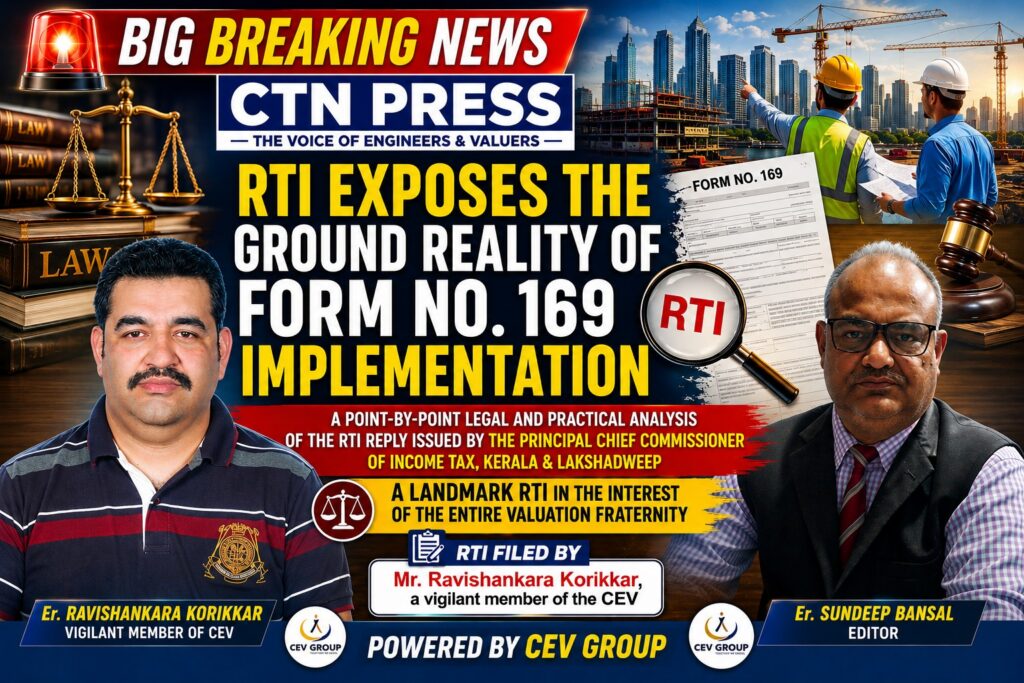


RTI EXPOSES THE GROUND REALITY OF FORM NO. 169 IMPLEMENTATION
A Point-by-Point Legal and Practical Analysis of the RTI Reply Issued by the Principal Chief Commissioner of Income Tax, Kerala & Lakshadweep
A Landmark RTI in the Interest of the Entire Valuation Fraternity
By Research & Policy Cell
Council of Engineers & Valuers (CEV Group)
Introduction
The transition of existing valuers registered under Section 34AB of the Wealth-tax Act, 1957 into the new regime introduced under the Income Tax Act, 2025 has generated numerous practical questions across India.
To remove uncertainty, Mr. Ravishankara Korikkar, a member of the Council of Engineers & Valuers (CEV Group), filed an RTI application before the Office of the Principal Chief Commissioner of Income Tax, Kerala & Lakshadweep seeking clarification on several operational aspects relating to Form No. 169.
The RTI reply dated 14 July 2026 provides one of the earliest official departmental clarifications on the implementation of Section 514 of the Income Tax Act, 2025 read with Rules 246 and 247 of the Income Tax Rules, 2026.
Although the reply pertains to the Kerala & Lakshadweep Region, many of the principles have nationwide relevance because they relate to statutory provisions applicable throughout India.
This article provides a detailed point-wise analysis of every reply received under the RTI and explains its practical implications for Registered Valuers.
Legal Background
Section 514 of the Income Tax Act, 2025 provides a transitional mechanism enabling existing valuers registered under Rule 34AB of the Wealth-tax Rules to migrate into the new valuation framework.
The prescribed application is Form No.169.
The RTI sought to clarify several practical issues including:
- Mode of filing
- Manual submission
- Postal submission
- Acknowledgement procedure
- Status tracking
- Processing authority
- Disposal period
- Existing departmental guidelines
The replies now throw considerable light on how the Department presently intends to administer these applications.
POINT 1
Whether any Circular, SOP or Official Guideline exists prescribing the mode of submission?
RTI Reply
No such information exists as on date.
Analysis
This is perhaps the most significant reply.
Normally, whenever a new statutory form is introduced, the Department simultaneously issues:
- Circulars
- Standard Operating Procedures (SOPs)
- Internal Instructions
- Filing Guidelines
- FAQs
- Public Notifications
However, the RTI confirms that no such official instructions presently exist.
Practical Impact
This means applicants cannot be denied merely because they adopted one reasonable mode of filing instead of another.
Since no departmental procedure exists, applicants must rely only upon:
- Section 514
- Rule 246
- Rule 247
- General principles of administrative law.
POINT 2
Can Form No.169 be submitted manually?
RTI Reply
Yes.
The application may be submitted:
- at Aaykar Seva Kendra
- by Registered Post
- by Speed Post
- addressed to the jurisdictional Principal CCIT/CCIT.
Analysis
This is an extremely important clarification.
Many valuers believed that filing would only become valid after an online portal was launched.
The Department has now officially clarified that manual filing is permissible.
Practical Procedure
Applicants should:
- Fill Form No.169.
- Attach all supporting documents.
- Submit physically or send through Registered/Speed Post.
- Preserve proof of dispatch.
- Preserve postal tracking report.
- Preserve copy of complete application.
These documents may become crucial evidence in future disputes.
POINT 3
Legal Authority permitting Manual Submission
RTI Reply
The authority flows from:
- Section 514 of Income Tax Act, 2025
- Rules 246 & 247 of Income Tax Rules, 2026.
Analysis
The Department has not relied upon any Circular.
Instead, it has relied directly upon statutory provisions.
This implies:
The Act itself authorises filing.
The Rules prescribe Form No.169.
No additional administrative approval is necessary.
POINT 4
Whether applications received through Registered Post are valid?
RTI Reply
Yes.
Applications received through post are valid.
Analysis
This clarification has tremendous evidentiary value.
Many professionals prefer Registered Post because:
- it creates documentary evidence;
- postal tracking is available;
- proof of delivery exists;
- future disputes can be avoided.
The RTI confirms that postal delivery satisfies the filing requirement.
Recommended Procedure
The safest method may be:
- Registered Post with Acknowledgement Due (RPAD), or
- Speed Post with online delivery confirmation.
Additionally:
- keep scanned copies;
- preserve postal receipts;
- maintain a filing register.
POINT 5
How can acknowledgement be obtained?
RTI Reply
Acknowledgement can be obtained by filing manually at Aaykar Seva Kendra.
Analysis
Applicants filing personally should insist upon:
- inward seal,
- receiving stamp,
- date,
- signature,
- office seal.
Never leave the office without obtaining documentary proof of filing.
POINT 6
Whether File Number is allotted?
RTI Reply
Yes.
A File Number is allotted after receipt.
Analysis
This is an important administrative safeguard.
The allotment of a file number confirms that:
- the application has entered the official records;
- departmental processing has commenced.
Applicants should always request the allotted file number for future correspondence.
POINT 7
How can applicants know the status?
RTI Reply
Status can be obtained through:
- letter.
Analysis
Since there is no online portal, applicants should periodically write to the jurisdictional office requesting status updates.
Suggested interval:
Every 30–45 days.
POINT 8
Is there any Online Status Tracking Facility?
RTI Reply
No.
Analysis
Presently, there is no online dashboard similar to:
- PAN
- TAN
- Income Tax Return
- GST
- MCA
Therefore applicants cannot monitor their applications electronically.
POINT 9
If no online facility exists, what alternative mechanism exists?
RTI Reply
No such information exists.
Analysis
This indicates an administrative gap.
Although applications are accepted manually, there is no prescribed public mechanism for:
- status tracking;
- progress reports;
- deficiency notices;
- communication timelines.
This highlights the need for a nationwide standardised tracking system.
POINT 10
Which authority processes Form No.169?
RTI Reply
The competent authority is:
- Principal Chief Commissioner of Income Tax, Kerala & Lakshadweep; or
- Chief Commissioner of Income Tax, Thiruvananthapuram,
depending upon PAN jurisdiction.
Analysis
Jurisdiction depends upon the applicant’s PAN.
Therefore, valuers should verify:
- PAN jurisdiction;
- correct office;
- correct postal address;
before dispatching the application.
POINT 11
Time Limit for Disposal
RTI Reply
Rule 247(9) provides:
Application may be disposed of within six months from the end of the month in which the application is made.
Analysis
Suppose application is filed:
15 August 2026
End of month:
31 August 2026
Maximum disposal period:
Up to 28 February 2027.
Applicants should therefore avoid unnecessary follow-up immediately after filing and instead monitor the six-month statutory period.
POINT 12
Whether any Internal Instructions exist for processing Form No.169?
RTI Reply
No such information exists.
Analysis
This is another important disclosure.
The Department confirms that no internal SOP or processing guidelines presently exist.
This may lead to:
- different practices in different States;
- varied documentation requirements;
- inconsistent processing timelines.
A centralised SOP from CBDT would greatly enhance uniformity.
The Supreme Court Reference
The RTI reply cites the decision of the Supreme Court in CBSE v. Aditya Bandopadhyay, (2011) 8 SCC 497, clarifying that a public authority is required to provide only information that already exists in its records. It is not obliged to create new information, offer opinions, or compile material that is not maintained. This explains why several RTI queries received the response “No such information exists as on date.”
Practical Procedure for Existing Registered Valuers
Based upon the RTI reply, existing valuers should follow the following procedure:
Step 1
Download and carefully fill Form No.169.
Step 2
Attach all prescribed supporting documents.
Step 3
Verify PAN jurisdiction.
Step 4
Submit:
- personally at Aaykar Seva Kendra, or
- through Registered Post/Speed Post.
Step 5
Preserve:
- acknowledgement,
- postal receipt,
- tracking report,
- copy of application.
Step 6
Obtain the allotted file number wherever possible.
Step 7
Seek periodic status updates through email or written correspondence.
Step 8
Maintain a complete record of every communication until disposal.
Key Takeaways
The RTI establishes several important operational principles:
- Manual filing of Form No. 169 is valid.
- Submission through Registered Post or Speed Post is accepted.
- Applications are allotted a file number after receipt.
- Acknowledgement is available for applications filed at Aaykar Seva Kendra.
- Status updates may be sought through email or letter.
- No online status-tracking facility presently exists.
- No departmental SOP, circular, or public guideline governing the filing or processing of Form No. 169 is available as of the date of the RTI reply.
- The statutory disposal period is six months from the end of the month in which the application is made.
Final Words
The RTI filed by a vigilant member of The Council of Engineers & Valuers Mr. Ravishankara Korikkar has provided valuable clarity on several practical issues affecting thousands of existing registered valuers transitioning under the new Income Tax valuation regime. While the responses confirm that manual and postal filing are recognised and identify the competent authorities and statutory timelines, they also reveal significant administrative gaps, including the absence of standard operating procedures, public guidelines, and an online tracking mechanism.
These findings underscore the need for the Central Board of Direct Taxes (CBDT) to issue comprehensive nationwide instructions, introduce a uniform digital filing and tracking system, and standardise the processing of Form No. 169 across all jurisdictions. Until such measures are implemented, valuers should adopt meticulous documentation practices, preserve complete records of submission, and proactively monitor the status of their applications.
The RTI serves not only as an individual response but also as an important reference document for the valuation profession, promoting transparency, procedural certainty, and better compliance during the transition to the new legal framework.

VIEW FULL VIDEO
Published by: Council of Engineers and Valuers (CEV)
READ THE COMPLETE RTI REPLY


KEY ASPECTS RELATING TO VALUERS