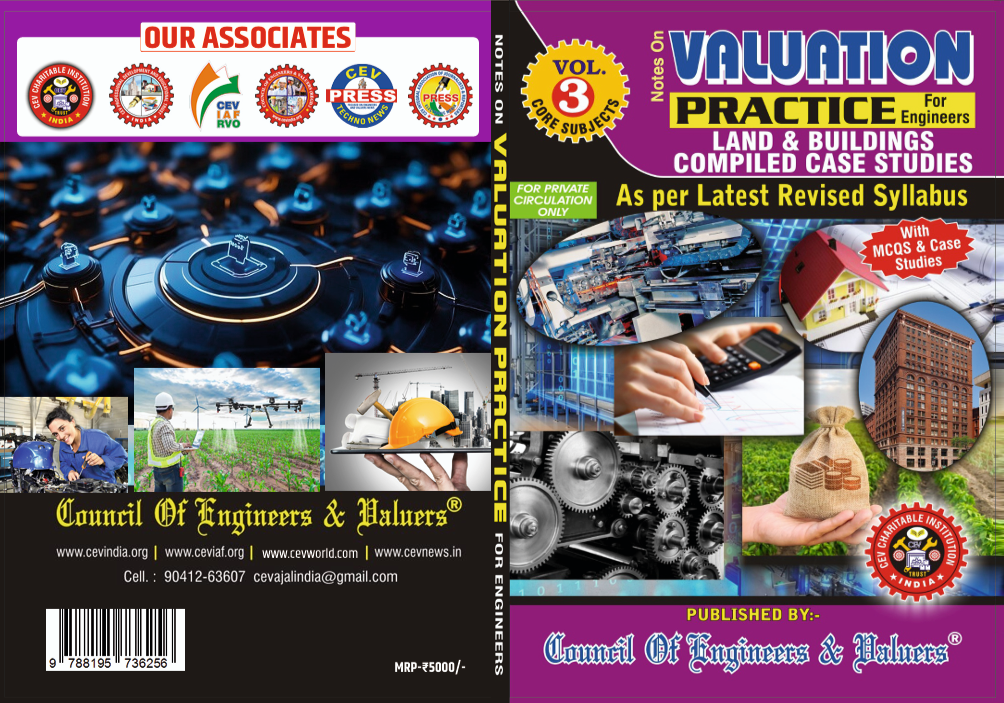
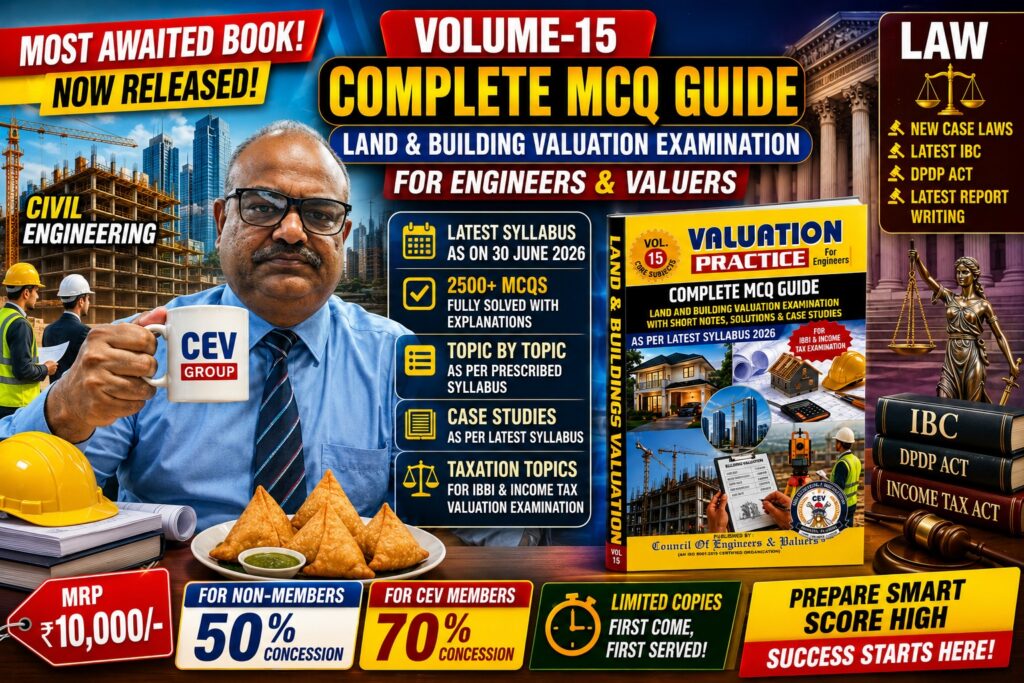
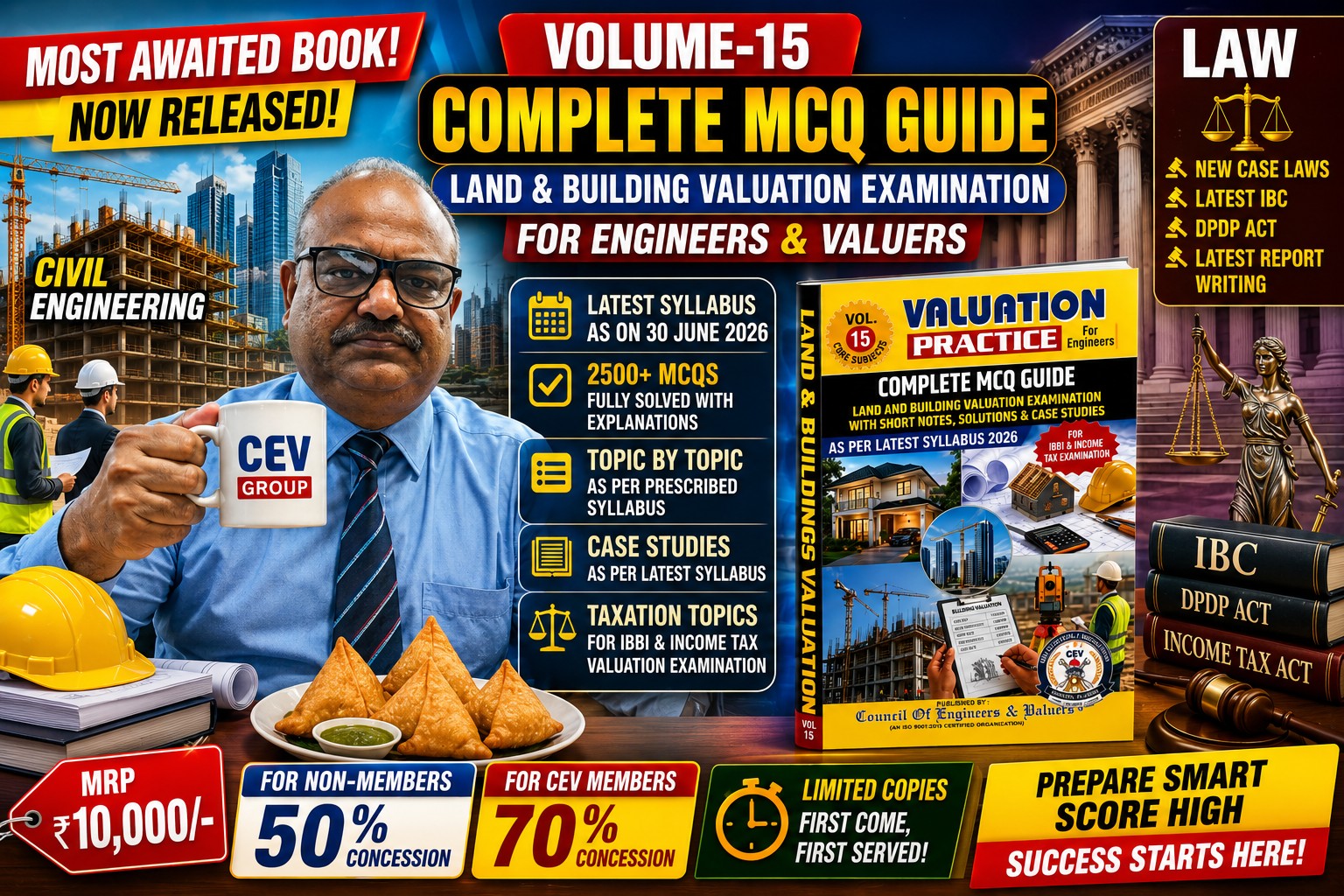
VOLUME-15
COMPLETE MCQ GUIDE FOR LAND & BUILDING VALUATION EXAMINATION
By CEV Publication House
A New Benchmark in Valuation Education
CEV Publication House Launches Volume–15 MCQ Guide for Valuation Examination
2500+ Solved MCQs, 20 Practical Case Studies and Comprehensive Coverage of the Income Tax Act, 2025 & Income Tax Rules, 2026
By Staff Correspondent
The valuation profession in India is witnessing an unprecedented transformation. With the introduction of the Income Tax Act, 2025, the Income Tax Rules, 2026, continuous amendments in the regulatory framework, and the growing expectations from Registered Valuers, the demand for structured, concept-oriented, and examination-focused study material has never been greater.
Addressing this critical need, CEV Publication House has launched Volume–15: MCQ Guide for Valuation Examination, a comprehensive reference book specifically designed for aspirants preparing for valuation examinations as well as practising valuation professionals seeking to strengthen their conceptual understanding.
The publication is being described by experts as one of the most comprehensive MCQ-based learning resources available for the valuation profession in India.
A Complete Examination Companion
Unlike conventional MCQ books that merely provide questions and answers, Volume–15 has been developed as a complete learning manual.
Every Multiple Choice Question is accompanied by:
- Correct answer
- Detailed explanation
- Conceptual discussion
- Practical interpretation
- Examination-oriented approach
This unique methodology enables readers not only to identify the correct option but also to understand the reasoning behind every answer, thereby strengthening conceptual clarity.
The publication covers more than 2,500 carefully designed MCQs, systematically arranged according to the latest prescribed syllabus.
Prepared as per the Latest 2026 Syllabus
One of the most significant strengths of the publication is that it has been completely updated in accordance with the Latest Valuation Examination Syllabus, 2026.
The authors have ensured that every important amendment, regulatory development, and emerging examination trend has been incorporated.
The publication is expected to prove equally useful for candidates preparing for:
- IBBI Valuation Examination
- Income Tax Valuation Examination
- Professional Competency Development
- Academic Learning in Valuation
Special Focus on the Income Tax Act, 2025
For the first time, a valuation examination guide of this nature provides extensive MCQ coverage relating to the Income Tax Act, 2025 and the Income Tax Rules, 2026, particularly those provisions having a direct bearing on the valuation profession.
The publication introduces readers to the evolving statutory framework governing Registered Valuers under the new tax regime.
The inclusion of these topics makes the guide highly relevant for professionals preparing for future examinations under both regulatory systems.
Detailed Concept Notes Before Every Topic
Recognising that conceptual understanding is essential for long-term success, the authors have included concise yet comprehensive introductory notes before every chapter.
These topic introductions provide readers with:
- Basic concepts
- Legal background
- Practical relevance
- Important terminology
- Examination perspective
This approach transforms the publication from a simple question bank into a structured learning resource.
20 Practical Case Studies for Concept Building
One of the most distinctive features of Volume–15 is the inclusion of 20 specially designed case studies.
Rather than testing memory alone, these case studies encourage analytical thinking and practical application of valuation principles.
The case studies simulate real-life professional situations and are expected to help candidates:
- Develop logical reasoning
- Improve decision-making ability
- Understand practical valuation challenges
- Build confidence in handling examination case-based questions
Experts believe that this feature will significantly improve candidates’ problem-solving skills while simultaneously preparing them for professional practice.
Latest Case Laws and DPDP Act Included
Legal awareness has become an essential component of valuation practice.
Accordingly, the publication includes updated discussions and MCQs based on:
- Latest judicial precedents
- Newly prescribed case laws
- Regulatory developments
- DPDP Act
- Contemporary legal framework relevant to valuation
The integration of legal developments ensures that candidates remain updated with the latest examination expectations.
Topic-by-Topic Systematic Arrangement
The book follows a logical progression aligned with the official syllabus.
Each chapter has been carefully organised to facilitate step-by-step learning.
Readers can systematically complete one topic before moving to the next, making revision easier and more effective.
This structured approach also enables coaching institutions and trainers to use the publication as a classroom reference.
Designed for Better Examination Performance
Educational experts associated with the publication have focused not merely on increasing the number of questions but on improving learning outcomes.
Every chapter has been prepared with the objective of helping candidates:
- Build strong conceptual foundations
- Develop analytical thinking
- Master examination techniques
- Improve accuracy
- Enhance speed
- Score higher marks
The detailed explanations accompanying each MCQ reduce dependence on multiple reference books and help students revise efficiently.
Useful Beyond Examinations
Although primarily developed for valuation examinations, Volume–15 is equally valuable for practising professionals.
Registered Valuers, Engineers, Chartered Accountants, Company Secretaries, Cost Accountants, Architects, Bankers, Financial Institutions, Insolvency Professionals, Legal Professionals, Academicians, Researchers and valuation consultants can use the publication as a practical desk reference.
Its comprehensive explanations make it useful even after qualifying the examination, serving as a ready reckoner during professional assignments.
Bridging Theory and Practice
Modern valuation practice demands much more than theoretical knowledge.
Professionals are increasingly expected to interpret laws, understand judicial precedents, analyse practical situations, and apply valuation principles with confidence.
Volume–15 attempts to bridge this gap by combining:
- Conceptual learning
- Examination preparation
- Legal understanding
- Practical application
- Analytical case studies
This integrated learning model represents a significant advancement in valuation education.
Raising the Standard of Valuation Learning
The valuation profession continues to expand into diverse sectors including taxation, insolvency, banking, financial reporting, mergers and acquisitions, litigation support, infrastructure, insurance, and corporate restructuring.
As professional expectations continue to rise, high-quality educational resources become increasingly important.
With its comprehensive coverage, detailed explanations, updated legal content, practical orientation, and examination-focused approach, Volume–15: MCQ Guide for Valuation Examination is expected to become an indispensable resource for the valuation fraternity.
The publication reflects the growing emphasis on knowledge-based professional development and aims to equip aspiring valuers with the confidence, competence, and conceptual clarity necessary to excel in both examinations and professional practice.
As India moves towards a more structured and regulated valuation ecosystem, resources such as this are likely to play an important role in shaping the next generation of valuation professionals.
For aspirants, educators, and practising professionals alike, Volume–15 is more than a question bank—it is a comprehensive knowledge companion designed to support excellence in valuation.
CONTENTS COVERED IN VOLUME–15 MCQ GUIDE FOR VALUATION EXAMINATION
| CHAPTER
NUMBER |
CONTENTS |
| 1 | PRINCIPLES OF ECONOMICS –
MICROECONOMICS · Consumption: Indifference curve, consumer surplus, elasticity:• Price mechanism: determinants of price mechanism; individual and market demand schedules; conditions, exceptions, and limitations of law of demand; individual and market supply schedules; conditions and limitations of law of supply; highest, lowest and equilibrium price; importance of time element • Pricing of products under different market conditions: perfect and imperfect competition, monopoly etc. • Factors of production and their pricing: land, labour, capital, entrepreneur, and other factors • Theory of rent • Capital and interest: types of capital, gross interest, net interest • Organisation and profit: functions of entrepreneur; meaning of profit and theories of profit MACROECONOMICS ·Functions and role of money • Inflation: types of inflation; causes and effects of inflation; Inflationary gap• Control of inflation: monetary, fiscal, and direct measures • Deflation: causes and effects of deflation; deflationary gap; measures to control deflation; deficit financing • Savings and investment: savings and types of savings; determinants of savings; investment and types of investment; determinants of investment; relationship between savings and investment • Components of economy: primary sector, secondary sector, tertiary sector; informal sector in urban economy; parasitic components in urban economy • Concepts of gross domestic product and gross national product; capital formation etc. • Definition of parallel economy; causes of parallel economy and effects on use of land and its valuation • Impact on real estate market and construction industry |
| 2 | BOOK-KEEPING AND ACCOUNTANCY
• Meaning and objects of book-keeping; double entry book-keeping • Books of prime entry and subsidiary books: cash book, bank book, journal, ledger, purchase and sale books, debit and credit notes register; writing of books; posting and closing of accounts • Trading account; profit and loss account; income and expenditure account • Preliminary analysis of financial statements • Cost and costing; elements of cost – fixed expenses, variable expenses, break-even point |
| 3 | LAWS – GENERAL
• Indian legal system: salient features of the Indian Constitution, fundamental rights, directive principles of state policy • Government: executive, legislature, and judiciary • Laws of contract: formation of a contract, parties, void, voidable and unenforceable contract, contingent contract, misrepresentation, fraud, and effect thereof, termination of contract, remedies for breach, performance of contract, indemnity and guarantee, law of agency • Tort: general principles of tort, tort affecting valuation • Law of arbitration and conciliation: salient features • Auction: authority of auctioneer, duties of vendor, purchaser and public, mis-description and misrepresentation, advertisements, particulars and catalogues, statements on the rostrum, conduct of sale, reservation of price, right to bid, bidding agreements, memorandum of the sale, deposit, rights of auctioneer against vendor and purchaser • Laws of evidence: burden of proof, presumptions, conclusive proof • The Insolvency and Bankruptcy Code, 2016 (IBC) and Regulations made thereunder. • The Companies Act, 2013: Section 192(2), 230 (1), 230 (2), 230 (3), 231, 232, 247 and 281(1) • Salient features of the Companies (Registered Valuers and Valuation) Rules, 2017 • Salient features of the Securitisation and Reconstruction of the Financial Assets and Enforcement of Security Interest Act, 2002 (SARFAESI Act, 2002) concerning valuation • Section 5(n) of the Banking Regulation Act, 1949 on “secured loan or advance” |
| 4 | INTRODUCTION TO STATISTICS
• Data classifications and processing, graphical representation of data, frequency distributions • Measures of central tendency, dispersion, and skewness • Elementary theory of probability and probability distributions, sampling, and sampling distributions • Simple test of significance, regression and correlation, multiple correlation coefficient • Time series • Index numbers |
| 5 | ENVIRONMENTAL ISSUES IN VALUATION
Environment and valuation – differences between the market price and the negative value consequent on environmental impact • Environmental issues of air pollution, water pollution, environmental factors and their effects, measures to restore the damage, cost to cure • Outlines of environmental legislations: the Indian Forest Act, 1927, the Water (Prevention and Control of Pollution) Act, 1974, the Air (Prevention and Control of Pollution) Act, 1981, the Environment (Protection) Act, 1986 • Laws related to industrial health and safety |
| 6 | PROFESSIONAL/BUSINESS ETHICS AND STANDARDS
• Model code of conduct under the Companies (Registered Valuers and Valuation) Rules, 2017: professional competence and due care, independence and disclosure of interest, confidentiality, information management, gifts, and hospitality • Integrity and fairness, remuneration and costs, occupation, employability and restrictions, business ethics • Ethical considerations under terms of engagements: engagement letter, management representation, guidance on use of work of experts, independence and conflict of interest, quality review process of valuers, rights, and responsibilities of valuers • Digital Personal Data Protection Act, 2023 and rules made thereunder |
| 7 | LAWS RELATED TO REAL ESTATE
• Land acquisition – the right to fair compensation and transparency in the land acquisition, the Rehabilitation and Resettlement Act, 2013 • General building rules and regulations • Rent control laws: sections pertaining to occupancy rights of tenants, freezing of rent, protection against eviction of tenant and its effect on value of property • Right of way and Section 52 – licenses under the Indian Easements Act, 1882 • Salient features of the Real Estate (Regulation and Development) Act, 2016 and regulating authorities established under the Act • The Transfer of Property Act, 1882: transfer of immovable property, sale, mortgage, gift, exchange, assignment, charge, lien, tenancies/sub-tenancies; lease of immovable property; lease granted by private and statutory bodies – impact of each on valuation; Sections: 3, 5, 6, 7, 25, 53 and 53A of the Transfer of Property Act, 1882 • Laws relating to inheritance/succession: Mohammedan: Muslim Personal Law; the Hindu Succession Act, 1956, the Hindu Succession (Amendment) Act, 2005; the Indian Succession Act, 1925: law of succession for person other than Hindu and Mohammedan; will & testament, succession certificate |
| 8 | A. VALUATION OF REAL ESTATE
• Cost, price, and value • Types of value • Basic elements of value – marketability, utility, scarcity, and Transferability • Factors affecting value – physical, economic, legal, and social • Highest and best use, value in use, value in exchange • Real property: rights and interests in real estate; types of ownerships and types of occupancy in real estate • Annuities; capitalization and rate of capitalization; years purchase; sinking fund; redemption of capital; reversionary value • Construction and use of valuation tables • Urban infrastructure and its influence on value of real estate • Real estate market and its characteristics; investment in real estate; factors influencing demand and supply schedule in real estate • Concepts of green building INCOME APPROACH TO VALUE • Relation between income and value • Valuation of property affected by the Rent Control Acts; licensed property under the Easement Act, 1882; leasehold properties under the Transfer of Property Act, 1882 • Derivation of yield rate from market derived data • Remunerative rate of interest and accumulative rate of interest • Types of rent: outgoings, income, yield, years purchase • Determination of market rent and standard rent • Lease – lessor and lessee: types of lease; lease provisions and covenants • Valuation of lessor’s interest, lessee’s interest including sub-lease in leased property; premature termination of lease or surrender of lease • Real estate as an investment; yield from real estate vis-à-vis other forms of investments; sound investment comparison • Investment decisions: discounted cash flow techniques, internal rate of return, net present value and capital assets pricing model • Profit method for valuation of special properties: hotels, cinema, mall, petrol pump, hill resorts MARKET APPROACH TO VALUE · Types of market · Market survey and data collection; sources of sale transactions · Comparison of sale instances: factors of comparison and weightages for adjustment in value • Hedonic model and adjustment grid model under sales comparison method • Land characteristics and its effect on land values • Hypothetical plotting scheme for value of large size land • Residue technique and other development methods • Valuation for joint venture development of property COST APPROACH TO VALUE • Methods of cost estimates for buildings • Life of building: economic, physical, legal • Factors affecting life of the building • Total life, age, estimating future life • Various methods of computation of depreciation, functional, technological, and economic obsolescence • Reproduction cost/replacement cost, depreciated replacement cost (DRC) working, adopting DRC as value subject to demand and supply aspect • Land value by market approach and building value by cost estimation method for owner occupied bungalows, factories, public buildings VARIOUS PURPOSES OF VALUATION • Valuation of properties for purposes such as: bank finance, auction reserve, building insurance, sale, purchase, valuation disputes in court, probate, partition, rent fixation, stamp duty, capital gains tax, lease and mortgage of property, any other purposes not referred above. • Guidelines issued by the IBBI for Conducting Valuation under the Insolvency and Bankruptcy Code, 2016 inter alia, covering the documentation, content of the valuation report, valuation of receivables, asset-specific formats for the valuation report and role of coordinating valuer in determining Fair value of the Corporate debtor. • The latest International Valuation Standards (IVS), as updated in January 2025 by the International Valuation Standards Council (IVSC). • Indian accounting standards (Ind AS 16, Ind AS 36, Ind AS 40, Ind AS 113) as applicable to valuation • Valuer as an expert witness in court • Valuers’ functions & responsibilities, error of judgement and professional negligence |
| 9 | PRINCIPLES OF INSURANCE AND LOSS ASSESSMENT
• Principles and legal concepts in relation to insurance of buildings; contract of insurance; insurable interests; liability to insure; duties of the insurer and the insured • Types of fire policies; reinstatement value, indemnity policies and policies for other perils; terms and conditions; perils, beneficial and restrictive clauses • Value at risk, sum insured and condition of average, over and under insurance; provisions regarding inflation, depreciation, obsolescence, and betterment; other provisions • Preparation of claim for damages due to insured perils • Obligations and rights of insurer and insured |
| 10 | REPORT WRITING
• Reports: quality, structure, style • Report writing for various purposes of valuation: sale, purchase, purchase, mortgage, taxation, insurance, liquidation etc. • Contents of the report: instruction of clients; date as on which valuation is made and date of report; site inspection; location; ownership history; data collection and analysis; type of construction; valuation method; value estimation; assumptions and limiting conditions including caveats and conclusion |
| 11 | IMPORTANT CASE LAWS ON PRINCIPLES OF VALUATION OF REAL ESTATE
• R.C. Cooper Vs. Union of India, (1970) AIR SC 564 • Sorab D. Talati Vs. Joseph Michem, Appeal No. 101 0f 1949 in R.A. Application No. 805 of 1948 • CWT Vs. P.N. Sikand (1977) 107 ITR 922 (SC) • Wenger & Co. Vs. DVO (1978) 115 ITR 648 Delhi HC • Jawajee Nagnathan Vs. Revenue Divisional Officer (1994) SCC (4) 595 (SC) • Chimanlal Hargovinddas Vs. SLAO, Pune AIR 1988 SC 1652 • CED Vs. Radhadevi Jalan (1968) 67 ITR 761 (Cal) • CIT Vs. Ashima Sinha (1979) 116 ITR 26 (Cal) • CIT Vs. Anupkumar Kapoor & others (1980) 125 ITR 684 (Cal) • CIT Vs. Smt. Vimlaben Bhagwandas Patel (1979)118 ITR 134 (Guj) • Mano Alex v. National Highways Authority of India (NHAI), WP(C) No. 10240 of 2020, High Court of Kerala • Lal Chand v. Union of India & Anr., Supreme Court of India • Mehrawal Khewaji Trust v. State of Punjab, Supreme Court of India • Special Land Acquisition Officer v. Karigowda & Ors., Supreme Court of India • Bharat Kumar v. State of Haryana, Supreme Court of India |
| 12 | CASE STUDIES:
THREE CASE STUDIES ON VALUATION OF LAND AND BUILDING • One case study with six 2-mark questions, for 12 marks • One case study with four 2-mark questions, for 8 marks • One case study with three 2-mark questions, for 6 marks (This section will have case studies for application of valuation techniques. For each case there will be a comprehension narrating the transaction based on which questions will be asked from the case) |
| 13 | IMPORTANT MCQs ON TAXATION RELATED TO VALUATION
1. GENERAL INFORMATION & PROPERTY IDENTIFICATION AS PER FORM 170 2. MCQS ON SECTION 513 AND 514 3. MCQS ON SECTION 247 SEARCH AND SEIZURE 4. MCQ ON RULE 246 TO 249 5. MCQ ON UNDER SECTION 40 COMPUTATION OF INCOME 6. MCQS ON SECTION 41 – WRITTEN DOWN VALUE (WDV) OF DEPRECIABLE ASSET 7. CAPITAL GAIN UNDER SECTION 67- 8. CAPITAL GAIN UNDER SECTION 72 9. CAPITAL GAIN UNDER SECTION 90, 91 10. CAPITAL GAINS UNDER SECTION 197, 198 11. PENALTY UNDER SECTION 463 12. MCQS ON SECTIONS 116 & 117 – TREATMENT OF ACCUMULATED LOSSES AND UNABSORBED DEPRECIATION 13. MCQS ON SECTION 200 – TAX ON INCOME OF CERTAIN DOMESTIC COMPANIES -517 14. MCQS ON SECTION 33 – DEDUCTION FOR DEPRECIATION 15. MCQS ON SECTIONS 74 & 75 – CAPITAL GAINS IN CASE OF DEPRECIABLE ASSETS 16. MCQS ON SECTION 77 – SPECIAL PROVISION FOR COMPUTATION OF CAPITAL GAINS IN CASE OF SLUMP SALE 17. MCQS ON SECTION 78 – SPECIAL PROVISION FOR FULL VALUE OF CONSIDERATION IN CERTAIN CASES (STAMP DUTY PURPOSES) 18. MCQS ON SECTION 269 – ESTIMATION OF VALUE OF ASSETS BY VALUATION OFFICER 19. MCQS ON SECTION 277 – METHOD OF ACCOUNTING IN CERTAIN CASES (INVENTORY VALUATION) -555
|
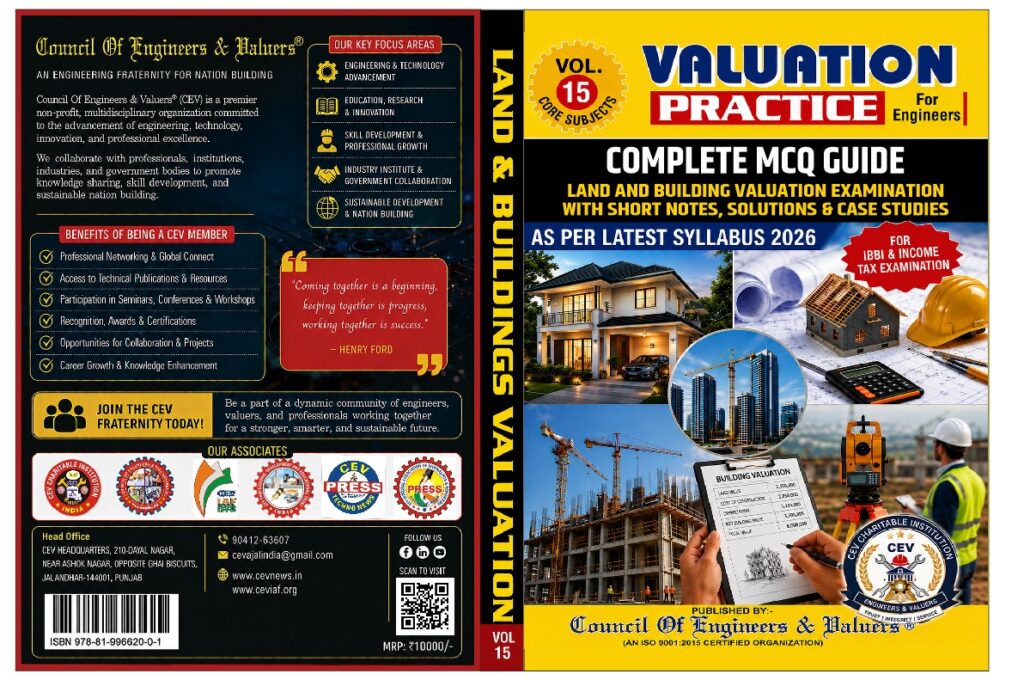
*🙋♂️🌹🚩📌VOLUME-15 ULTIMATE MCQ GUIDE FOR IBBI & TAXATION VALUATION EXAMINATION AS PER LATEST SYLLABUS 2026*